Clinical Applications of AI: From Predictive Analytics To Practice
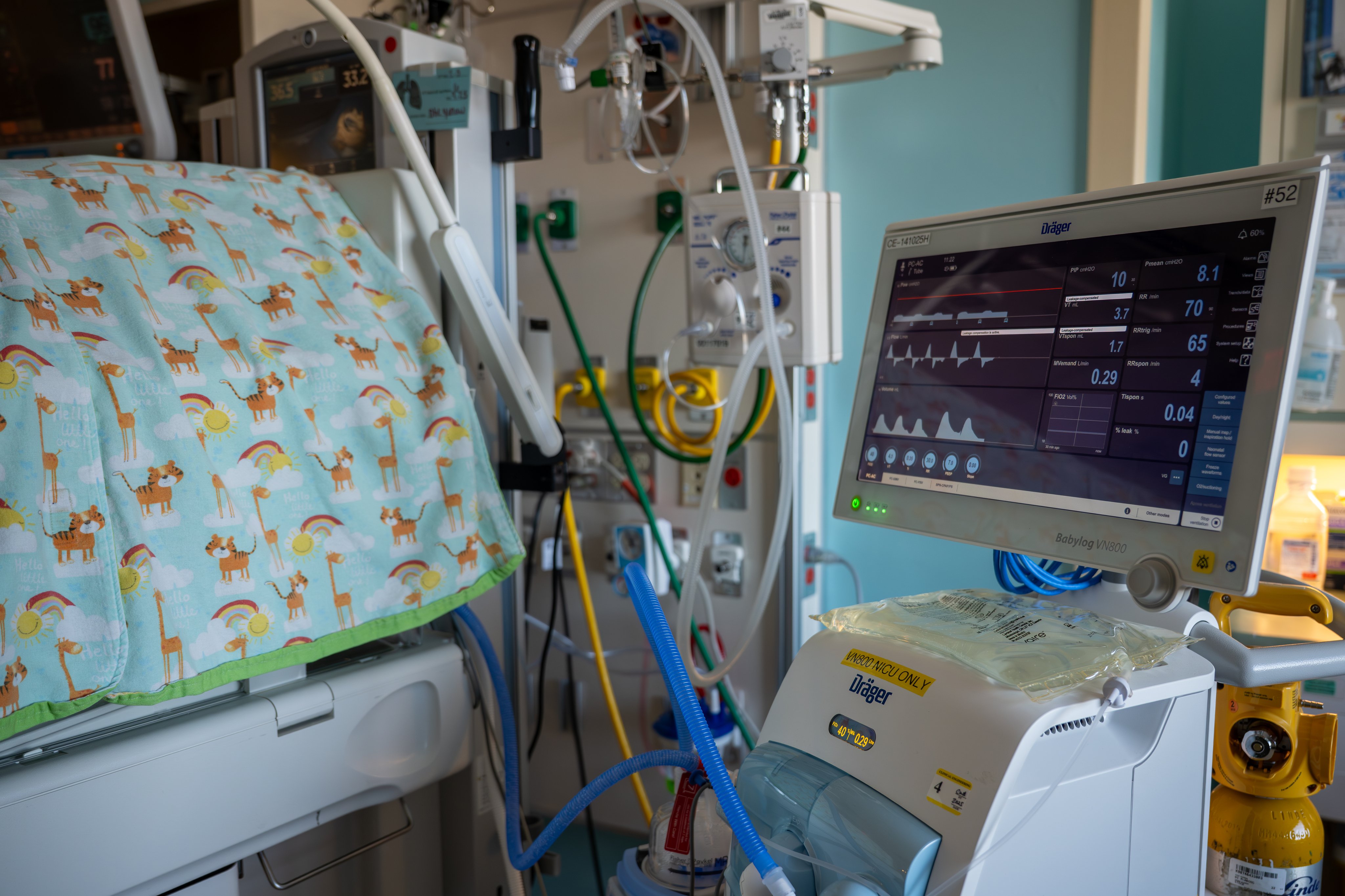
As health systems around the country struggle to overcome hurdles to implementing AI, UVA Health remains poised as a model of early adoption.
Since the early 2000s, UVA Health has led the way in developing systems that use predictive analytics and data modeling to inform patient care, while breaking down barriers such as technology integration and ongoing learning from data as a health system.
Brynne Sullivan, MD, MSc, the director of the UVA Center for Advanced Medical Analytics (CAMA), plans to build on the foundation already in place at UVA Health to inform the future — creating analytics that enable timely, focused precision medicine, and better patient outcomes.
A Career Shaped by Clinical AI
Sullivan is a neonatologist, treating patients in UVA Health Children’s Level IV neonatal intensive care unit (NICU). But the physician-scientist spends most of her time on clinical and computational research, with a focus on developing and testing predictive analytics in healthcare.
In fall 2024, Sullivan was named CAMA director, succeeding her mentor and the research engine’s founder, cardiologist Randall Moorman, MD, after his retirement.
Twenty-five years ago, Moorman’s pioneering work using heart rate changes to predict sepsis in preterm babies — giving doctors and nurses an early warning and more time to act. The randomized clinical trial to study the impact of the Heart Rate Observation (HeRO) monitor found that HeRO displays reduced sepsis-associated mortality by 40%.
This work set the stage for the research to expand into signals beyond heart rate, neonatal conditions beyond sepsis, and patient populations across the age span. Like CAMA, the AI application possibilities afforded by the original HeRO monitor in the NICU have grown and scaled over the past 10 years.
Where Medicine Meets Data Science
Sullivan now directs a robust team at CAMA, including clinicians, researchers, data scientists, and engineers across disciplines. The team collaborates with departments and schools across grounds, including the School of Medicine Departments of Medicine, Pediatrics, Surgery, Emergency Medicine, and Public Health Sciences, as well as the Schools of Data Science, Nursing, and Engineering.
Current neonatal projects include developing algorithms to predict other conditions, like necrotizing enterocolitis (NEC) and respiratory failure requiring intubation. They’re also developing a wireless device that uses algorithms to monitor infants at risk for neonatal opioid withdrawal syndrome (NOWS). Because intervention assessments are currently subjective — typically based on criteria including whether a baby is jittery, hard to console, or struggles with eating — an algorithm trained to recognize patterns in vital signs of babies with severe withdrawal can provide more objectivity to clinical decision support, she says.
Clinical Applications Beyond the NICU
Across the health system — in other ICUs and hospital units — the team is also researching how to predict physiologic deterioration events. CAMA investigators Shrirang Gadrey, MD, and William Ashe, PhD developed a wireless device to measure breathing motion, or analysis of respiratory kinematics (ARK), in patients. Although the ARK device was first developed for adults in UVA’s exercise physiology lab, the researchers are now testing it in patients across the lifespan: in hospitalized adults, emergency medicine patients, children with asthma, and infants in the NICU.
Similarly, nurse-scientist Jessica Keim-Malpass, PhD, PNP, and her colleagues led a randomized clinical trial testing the Continuous Monitoring of Event Trajectories (CoMET) system, which applies continuous monitoring and computer algorithms to provide a visual display of a patient’s risk for experiencing a serious event over a 12-hour period. First developed for adult patients, the CoMET system is now used to monitor patients in the pediatric ICU (PICU).
Today, innovations developed at UVA Health, like HeRO and CoMET, are in use across the United States and the world, and others in development are being fast-tracked. For example, in 2024, the FDA awarded breakthrough device status to HeRO NOWS. This noninvasive, single-sensor monitor uses heart rate and respiratory rate data to optimize care for infants with opioid withdrawal syndrome.
From Big Data to Better Predictions
Another project Sullivan and the CAMA team are involved with is a multisite initiative called Bridge2AI CHoRUS, or Collaborative Hospital Repository Uniting Standards. The goal of the National Institutes of Health-sponsored study is to establish a robust dataset across 14 sites using the same standards. They compile these expansive AI-ready datasets to fuel learning models and create systems for early disease detection that are reproducible across centers.
“It’s an impressively large effort that demonstrates the reason why AI in healthcare isn’t easy,” Sullivan says. “In generative AI, the big chatbots are trained on the entire internet. They’re suitable if you need a standard response. But in healthcare, we’re trying to predict very specific clinical conditions and context, so we have to design each stage of algorithm development thoughtfully.”
Clinical Space Design for the Future
Sullivan and her colleagues are also working to design UVA Health Children’s NICU as it expands onto the 8th floor of the new South Tower, bringing the total number of beds in the unit to 100.
“We’ve been thinking and planning how to make the space a state-of-the-art NICU and outfit it for the future,” she says, noting they’ve had conversations around technology they want to implement and what’s coming down the development pipeline. “There are opportunities to advance the technology of all the equipment we use, especially how we monitor patients and bring the team to the right bedside at the right time.”
The expansion and completion of the overall South Tower project is slated to finish in early 2028.
What It Takes To Sustain AI Clinical Applications
As Sullivan looks ahead, a key consideration for CAMA and the clinical application of AI at UVA Health is resource allocation and future needs—ranging from infrastructure and research funding to data storage and on-the-ground support.
Sullivan notes that UVA has consistently demonstrated its belief in the effort and is committed to supporting the collaboration between the clinical and research sides.
“There are a lot of people at UVA thinking about how to lead in this area of predictive analytics and data modeling,” she says. “The health system is learning from all of these people across disciplines and channeling that excitement into an infrastructure that helps us grow and expand, and continue to be leaders in this rapidly growing field.”
Why Implementation Matters in Clinical AI
Finally, implementation of AI systems is critical, but it relies on buy-in from hospital administrators and clinicians, Sullivan says. That’s why it’s essential to create models that are pragmatic, as well as easy to understand and use. It’s also why implementation is a key focus for Sullivan in future trials.
“Over time, we’ve learned that the clinical context and workflow in the NICU or any clinical environment is incredibly complex, and there are a lot of factors that either increase or decrease the use of a system,” she says. “We’re now thinking more about implementation science and how we can make the design work exactly how it’s intended in a particular clinical space.”
Machine Learning and AI: The Role of Artificial Intelligence in Care
While discoveries driven by advanced medical analytics can improve patient care and outcomes, Sullivan stresses that they require substantial research and development before they can safely and effectively move from the computer lab to the bedside. She adds that these tools always depend on clinicians integrating human intelligence with artificial intelligence.
Machine learning can identify patterns that signal an increased risk of health deterioration. Sullivan emphasizes that clinicians must still evaluate each patient, applying both their observations and clinical judgment to deliver truly personalized care. Building systems that effectively integrate human and artificial intelligence is challenging, she says, but it is what sets UVA Health apart from other health systems.
“UVA Health has been unique in that we’re not just developing and publishing on predictive algorithms, we’re actually implementing it,” Sullivan says. “We’re studying and understanding how clinicians use these systems we build and how they impact patient care.”