When Doctor Becomes Patient: Mark Lepsch’s Open Heart Valve Surgery at UVA Health
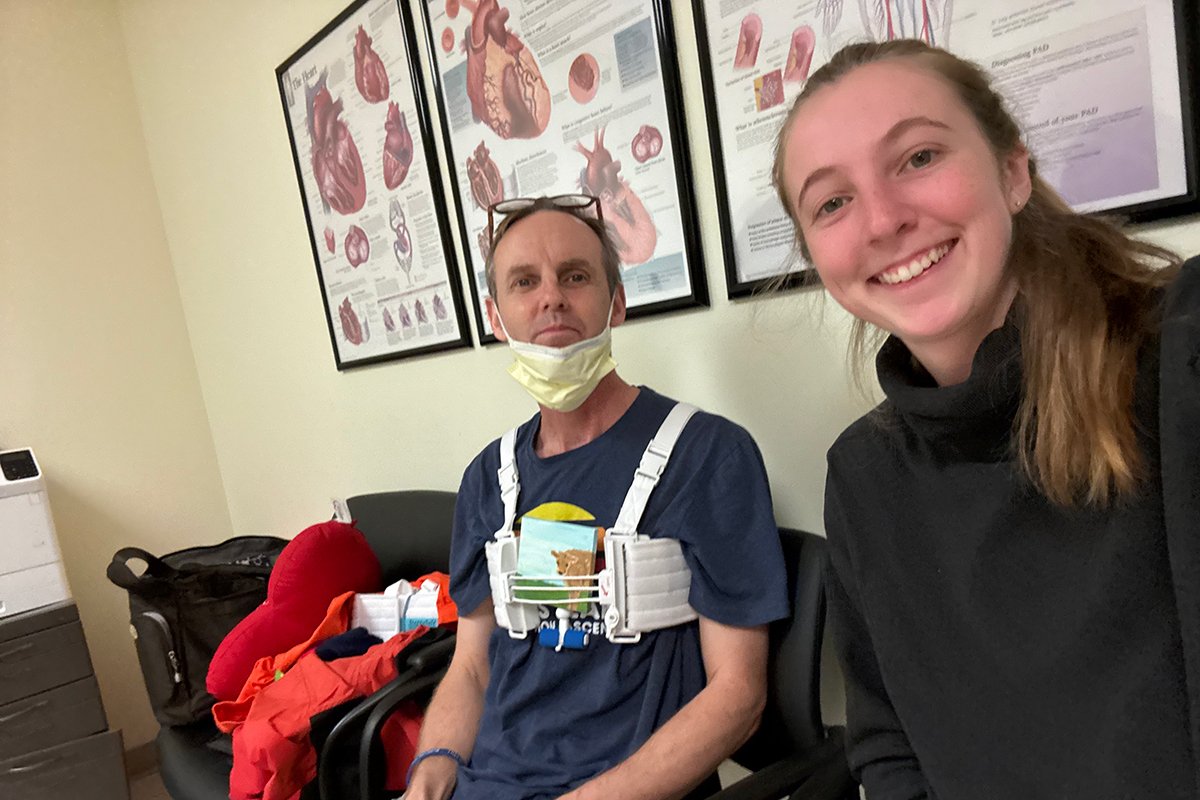
Mark Lepsch, MD, holding a small painting in his chest harness to honor his new heart valve.
Mark Lepsch, MD, has spent 21 years helping patients navigate some of the toughest moments of their lives. As a primary care physician at UVA Health’s Northridge Internal Medicine, he guides countless people through serious diagnoses, big decisions, and long recoveries. But on January 14, 2026, the roles were reversed. Mark was the one getting surgery and trusting someone else to give him a second chance at life.
He had open heart surgery to replace his aortic valve, the result of a condition he was born with. And there was another unique angle: Jared Beller, MD, an adult cardiac surgeon at UVA Health’s Heart and Vascular Institute, treated Mark’s aortic valve, but Mark is, in turn, Beller’s personal primary care physician.
A Condition He Was Born With
Mark’s heart condition has been with him from the start (called a congenital heart condition). He was born with a bicuspid aortic valve.
In most people, their aortic valve has three leaflets, or flaps, that open and close to control blood flow from the heart to the rest of the body. With a bicuspid aortic valve, there are only 2 leaflets. Mark's heart formed in such a way that 2 of the leaflets in his valve didn't separate. That small difference would quietly shape the next five decades of his life. “My understanding is that bicuspid aortic valves, depending on whose study you read, are not that uncommon,” Mark explains.
For most of his life, he had no idea there was a problem. He ate well, exercised six or seven days a week, and doesn’t drink alcohol. “I have a terrible family history of cardiovascular disease. Three out of four grandparents died in their 50s of heart attacks. My mother had very high cholesterol. So, fortunately I was raised to be very healthy, eat lots of fruits and vegetables, very healthy diet and exercise,” he says.
Then, at age 40, “I was having a few symptoms with intense exercise,” he says. A stress test with an echocardiogram raised the possibility that his valve might be bicuspid. But his cardiologist wasn’t sure, and Mark went about his life.
That changed at age 50. One day, he put a stethoscope to his own chest and noticed something different. “I suddenly had a much louder murmur than I had a year ago,” he recalls. A later echocardiogram confirmed it. His valve opening had shrunk significantly. It was time to start watching his health situation closely.
What Is a Bicuspid Aortic Valve?
Your aortic valve sits between your heart and the rest of your body. It opens to let blood flow out and closes to keep it from flowing back. Most people are born with three leaflets (flaps) on this valve. People with a bicuspid aortic valve are born with two.
Over time, a two-leaflet valve tends to thicken, stiffen, and narrow. This is called aortic stenosis. As the opening gets smaller, the heart has to work harder to push blood through. Without treatment, it can lead to heart failure.
People with three-leaflet valves usually don't develop serious problems until their 70s or 80s. Those with bicuspid valves, like Mark's, often run into trouble decades earlier.
When the Symptoms Could No Longer Be Ignored
About nine months before his surgery, things shifted. Mark started getting winded doing activities that used to be easy. He felt exhausted after minor illnesses that lingered for weeks. He got dizzy trying to exercise.
He researched every possible option. Was there a medication that could slow the disease? Could he qualify for a less invasive procedure later? The answer, every time, was no.
“I spent years reaching out to anyone and everyone to ask the question: is there anything I can do,” Mark recalls. “Unfortunately, what I was told is what I sort of already knew. It’s just a mechanical problem.”
“Around two months before surgery, the wheels really came off the train” he says. “I would get dizzy just sitting there. I couldn’t do anything except very gentle activity.”
It was time to act. Beller explains what was going on in Mark’s heart at the time: “In the last year, Mark started to notice that he was developing some more shortness of breath when he was doing activities that he used to be able to do. That corresponded to an increase in the gradient across the valve. And that really told us that it was time to start thinking about doing a surgery to replace his valve.”
A Unique Bond Between Doctor & Patient
As a physician, Mark was already familiar with UVA Health’s cardiovascular surgery team well. He had referred patients to them for years. He trusted their skill. But when it came time to choose his own surgeon, he knew Beller was who he wanted.
Their connection went beyond a typical doctor-patient relationship. Mark had been Beller’s personal primary care physician for years. The two had talked openly about aortic stenosis, and about the fears that came with the possibility of surgery, long before Mark became a cardiovascular patient himself.
"I met him while his stenosis was still in the moderate range,” says Beller. “We had an initial conversation to talk about different surgical options, what that might look like, and what the expected recovery was. I think he was pretty mentally prepared to go into surgery and was ready for all that comes with it.”
Mark has nothing but high praise for Beller. ”He’s a very kind, compassionate human, very intelligent. And if you ask any of the people who work with him, the term they use is unflappable. He’s calm, professional, and he has incredible skill. There was no question who I was going to ask to be my surgeon.”
Open Heart Surgery Was the Only Option
Today, most aortic valve replacements are done through a catheter (a thin tube inserted through the skin) with no need to open the chest. This type of [procedure, called transcatheter aortic valve replacement (TAVR), means a faster recovery and less risk for patients over an open-heart surgery.
But for Mark, TAVR wasn’t an option. Because of his age and the bicuspid shape of his valve, open heart surgery was the only path forward. “It was not appealing,” says Mark. But two things stayed constant: his trust in the UVA Health team, and the knowledge that surgery was his only way forward. “It was either do this surgery or slowly decline and die in the next few years,” he says. And so, in his mind, his feelings shifted. “Gratitude,” he recalls. “So thankful that this option existed. And humility because there wasn’t anything I could do except be a patient.”
“There was never a question about getting second opinions or going somewhere else, because I know their incredible skill, compassion, and dedication. They are really a team that is second to none,” says Mark.
Surgery, Minor Complications, & a Team That Had It Covered
The surgery itself went well. But recovery is its own journey.
About two hours after arriving in the intensive care unit (ICU), his blood pressure dropped dangerously low. The nurses responded within seconds. “They had the bed tilted, they hit the button on the IV machine, and within 10 seconds, my blood pressure was back,” Mark says. He also had low sodium levels and some bleeding from after-surgery medications. Each complication was quickly managed by the care team.
The UVA Health anesthesia team also used a technique called regional nerve blocks (targeted numbing medicine guided by ultrasound) instead of relying on heavy pain medications. It made a real difference.
“Pain was never an issue,” notes Mark. “It was all kinds of weird, strange symptoms that I never expected. And what was wonderful, once again, was the team: responsive, comforting, they asked all the right questions.”
Mark went home on day four, ahead of the typical five-to-seven-day hospital stay. Within six weeks, he was preparing to return to work. “Like all patients,” says Beller, “Mark went through some ups and downs during the recovery period. But overall, he did great and really made a rapid recovery back to feeling very well pretty quickly.”
A New Perspective & Appreciation
Mark says that the journey, from the moment he learned surgery was coming to the day he came home, gave him a deeper appreciation for what his own patients go through.
“You’re a little more patient, a little kinder, a little more understanding,” he says. “This surgery has probably not changed me as much as the whole experience starting nine months ago when I realized I was going to have to have it.”
For patients with a bicuspid aortic valve, or any serious heart condition, Mark has simple advice: pay attention to your symptoms, and don’t wait. “You really want to schedule surgery as soon as you start noticing symptoms and changes,” he says. “Every single person I’ve ever known who has been through a cardiovascular surgical procedure at UVA Health has said the same thing: while the procedure may not be fun, the teams and the people that are caring for you are top-notch,” says Mark.
Beller shares that same sentiment. “The mission of the Heart and Vascular Institute at UVA Health is really to treat every patient like they’re family, to give every patient the individualized care that they need, and really respond to any questions or concerns that they have as carefully and as fully as we can,” he says.
Today, Mark is recovering well and getting ready to return to the patients who have counted on him for more than two decades. As he puts it, he considers himself a better doctor for having been a patient.
See Mark tell his heart valve surgery journey in his own words in this video:
Mark Lepsch’s Open Heart Valve Surgery Journey
Mark Lepsch:
My name is Mark Lepsch. I turned 55 years old this past year. I've been a primary care physician at Northridge Internal Medicine for the last 21 years. I was a patient of the cardiovascular surgery service where I was given a second chance at life. I was born with a bicuspid aortic valve, two leaflets instead of three, and they tend to wear out often in your 50s and mine was done.
Dr Beller:
So for Mark, he's known about this for some time, the bicuspid valve, and it's been monitored over the years. In the last year, he started to notice that he was developing some more shortness of breath when he was doing activities that he used to be able to do.
Mark Lepsch:
It was just before I turned 55, about nine months ago, where I suddenly noticed things were different. I was out of reserve. If I got a little bit sick, it would last for weeks and I would be exhausted. But then around two months ago, the wheels really came off the train. And at that point, I had actually started to go into early heart failure.
Dr Beller:
Mark is younger than most of the patients that we treat with aortic stenosis, and along with that, he had some concerns about surgery at such a young age and what that might mean for the future. And so obviously, Mark was very knowledgeable about the subject and had a lot of ideas and thoughts about what that might look like. Together, we were able to come to a conclusion and a decision about when to have surgery and what type of surgery to have.
Mark Lepsch:
These days, probably a significant majority are done through catheters. They're no longer open heart procedures. My evaluation proceeded. It became clear that I was going to have to have open heart surgery, and quite frankly, that was terrifying. It was either do this surgery or slowly decline and die in the next few years. The one consistent and constant was that I never had anything but the utmost confidence in the cardiovascular surgery teams at UVA.
Dr Beller:
The procedure itself went really well. Mark did great during the operation and recovered very nicely afterwards. Like all patients, go through some ups and downs during the recovery period, but overall, he did great.
Mark Lepsch:
The team was as responsive, as comforting as possible. So I'm getting better and better and actually ahead of the curve and going back to work, not even six weeks after I had the surgery. I've been fortunate because I am emblematic of, you know, it takes a village. There has not been anyone from the entire cardiovascular surgery team to my family, to my friends, who has been anything other than wonderful. It's been really an honor and a great pleasure to heal and then be able to share with them that I'm healing, that I lived.