FitBone for Pediatric Limb Lengthening: Q&A
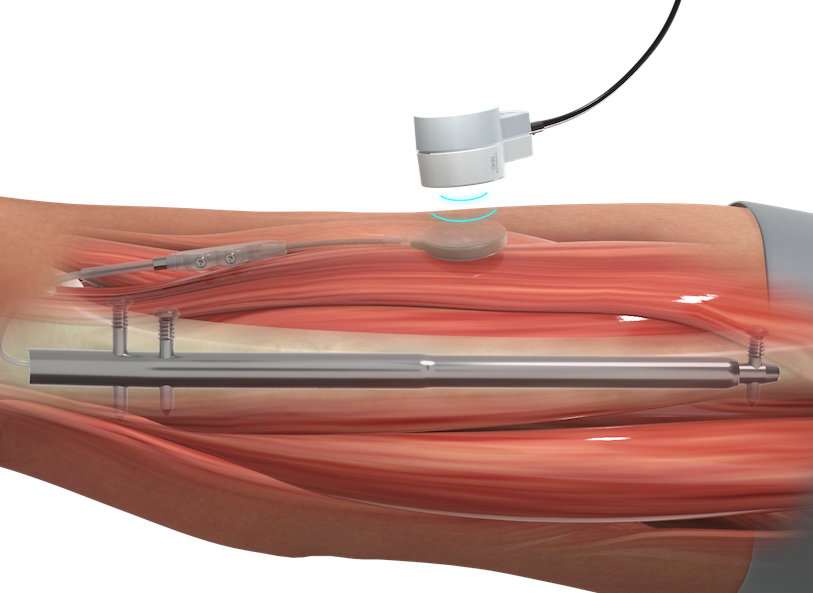
For children with limb length discrepancies, whether congenital or trauma-related, bone lengthening can help reduce strain on the spine, positively impact gait, and improve quality of life.
Internal lengthening devices offer favorable outcomes and high patient satisfaction. Patients prefer these devices for their accurate distraction, fewer complications, better alignment, and preserved joint motion. Medically, these devices are also less likely to cause infection and can be inserted through a minimally invasive process.
FitBone was authorized for pediatric use in 2021 and is still is only available at a few centers.
FitBone Q&A
Mark Romness, MD, answered questions about how this device works and why we’re excited to be able to offer it as an option to patients at UVA Health Children’s.
Do many kids grow out of limb length discrepancies without surgical intervention?
It’s rare. Only a few fractures are known to equalize without intervention. Congenital discrepancies will not correct without intervention.
What ages are we offering this device for?
Internal lengthening devices can be used at any age, but usually we’d recommend it for a teenager or older, when the growth plates are closed or nearly closed.
How does the FitBone compare to other methods for internal limb lengthening?
It uses a transcutaneous electrical signal to activate the lengthening, while Precise uses a transcutaneous magnetic field. The electrical signal approach offers more control.
After correction, does the internal nail stay in place or is it removed?
Removal of the internal nail is recommended due to its mechanical components. Typically, the device is removed about 1–2 years after implantation, once the bone has healed fully and is strong enough to support itself without the nail.
In addition to limb length discrepancies, FitBone appears to be approved for deformities. What types of deformities can it correct?
The FitBone device itself is designed to provide length only and does not correct deformity. However, surgeons can address angular or rotational deformities at the time of implantation, allowing both length and alignment to be corrected during the same procedure.
In one case, a patient with Perthes had both femurs lengthened. What would be the benefit of doing this?
If both femurs are shorter than expected, lengthening may be performed to improve overall stature, or height. That said, equalization of limb length is generally the primary goal, as symmetry plays a more important role in function and gait.
Would children with limb length discrepancy due to radiation for pediatric cancer be good candidates for this procedure, or are there additional concerns?
Lengthening after radiation is possible but can be more challenging due to changes in the bone, skin, and surrounding neurovascular structures. If the area requiring lengthening was not directly affected by radiation, these risks may be reduced, and the procedure may be more feasible.
If a child has scoliosis associated with limb length discrepancy, how is that approached?
Scoliosis and limb length discrepancy are generally considered separate conditions and are treated independently. Limb length discrepancy has not been shown to cause scoliosis except in extreme cases, so each condition is evaluated and managed based on its own severity and clinical impact.
For physicians considering referring a patient for FitBone evaluation, what information is most helpful?
Details about the cause of the limb length discrepancy are critical, along with any prior imaging, evaluations, or treatments. This information helps the care team assess candidacy and determine the most appropriate treatment approach.