A Social Media Post Led to a Kidney Match: Erik’s Kidney Transplant Story
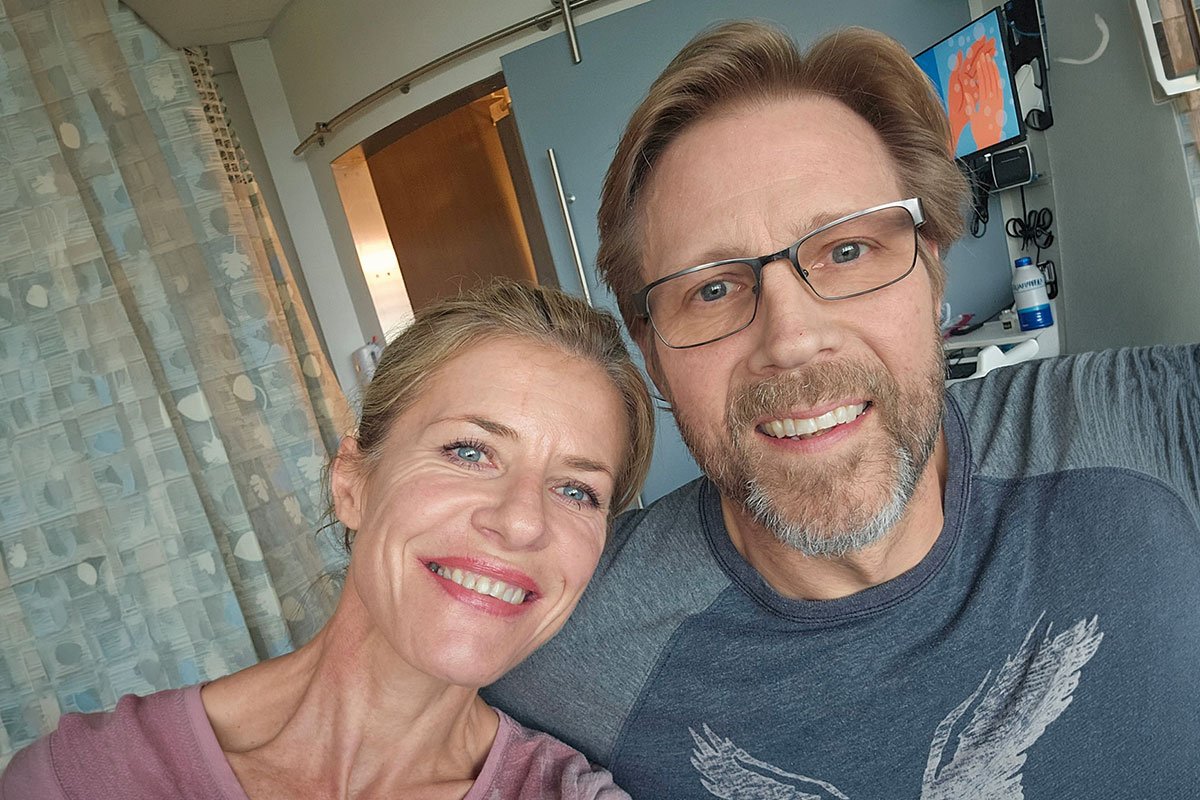
Erik Page and his wife Violetta
When Erik Page, 57, learned he needed a kidney transplant, he was told the wait could be up to 10 years. Instead, less than a month after his first visit to UVA Health, his phone rang with news that there was a match.
Erik is a husband, a father of two, and a martial arts black belt from Roanoke, Virginia. His path to kidney transplant started with a rare condition and a social media post his wife shared.
Years of Feeling Off
For a long time, Erik kept getting sick. He had pneumonia, a cough that wouldn’t go away, very high blood pressure, dizzy spells, and swollen ankles. Mostly, he was tired. “I felt like I weighed 1,000 pounds, but I also felt like I was completely hollowed out,” he says.
Blood work finally showed that his kidneys weren’t working well. A specialist thought Erik might have Alport syndrome, and it was confirmed in 2018. Erik’s brother has it, too, and he underwent a kidney transplant a few years ago. Erik notes the type of Alport syndrome he and his brother have makes a transplant almost certain.
What Is Alport Syndrome?
Alport syndrome is a rare condition that people are born with. Yazan Al-Adwan, MD, the surgeon at UVA Health provider who performed Erik’s transplant, says it's “a collagen disorder that affects the whole body.”
Tiny filters inside the kidneys clean toxins out of the body. In Alport syndrome, these filters slowly get damaged, and Al-Adwan says that damage can’t be undone. When the kidneys stop doing their job, the body needs outside help to filter toxins. That help is called dialysis.
Dialysis can keep people alive, but Al-Adwan says quality of life can decline over time.
Doing Everything He Could
Erik first set out to protect the kidney function he had left. He gave up alcohol, kept his diet simple, and lost 80 pounds in about 10 months. “I never gave up chocolate,” he smiles. “And I don’t think I ever will.”
He also returned to the martial arts he had practiced on and off for most of his life. A couple of months before his transplant, he earned his first-degree black belt. Erik believes these changes helped his kidneys last longer.
Choosing UVA Health for Kidney Transplant
After some time, Erik’s kidneys started to get worse. He learned that his kidney function had dropped low enough that it was time to plan for a transplant. He and his wife, Violeta, looked at several hospitals. They chose UVA Health because of its great reputation. “The quality of care was just through the roof,” Erik says of his first visits. The UVA Health team was also amazed at how strong he was, even with his kidney function so low.
They explained the next steps. Erik would start on the inactive list while he finished his tests, and then he could move to the active list. They also warned him about the wait. “I was told that it was going to be probably 10 years on the list,” he says.
Why Blood Type Matters
Organs are matched by blood type. Erik has type O blood.
Al-Adwan explains that type O is the most common blood group among people waiting for an organ. So people with type O often wait the longest for a kidney from a deceased donor.
At UVA Health, the average wait is 5-6 years, but for individuals it can be shorter or longer depending on blood type. That’s why the team sometimes suggests other paths, like a living donor or a direct donation.
A Social Media Post That Made a Difference
Erik and Violeta didn’t know how long they may have, so Violeta took the search to social media. A friend helped her make a flyer, and she posted it within a week of their visit to UVA Health.
Offers began to come in, though some people weren’t a match. Then a message came from someone who had heard about them. That person’s brother was on life support and was not expected to survive. They wanted to donate.
Erik tried to stay realistic. “Don’t get your hopes up,” he remembers thinking, “because the chances of there being a match is pretty slim.” Still, he was moved by how many people stepped up. “You can’t really put it into words,” he says. “It’s humbling.”
A Phone Call, a Helicopter, and a New Kidney
On August 18, Erik’s phone rang, and it was UVA Health calling to say they had a match.
“I’m like, What? What are you talking about?” he remembers. He hadn’t even finished the tests to reach the active list, and he was soon on his way to the hospital. “I’m in the room getting a kidney,” he says of the next day. “It was incredible.”
That night at the hospital, Erik barely slept. In the middle of the night, he heard a helicopter and thought it was probably his new kidney arriving. Before surgery could go ahead, Erik says his surgeon was kind and took time to talk and listen. “They were just amazing,” he says of the team. “I mean, every single one of them, nurses, doctors, everybody.”
“We do have an excellent team here at UVA Health,” agrees Al-Adwan. He remembers Erik as “an amazing and excellent patient.”
A Tougher Recovery Than Expected
Erik went home on Friday, but over the weekend his heart rate began to jump whenever he stood up. He stayed in close touch with his transplant team, and when it didn’t get better, he was taken to UVA Health. The team believed one of his antirejection medicines was the cause, so they lowered the dose. When the problem came back, they changed his medicine again and added others to help his heart.
More challenges followed. He had a blood clot in his leg, and doctors found that his body was starting to reject the new kidney. He needed three biopsies and strong treatments, including high doses of steroids. In all, he was in the hospital seven times after his transplant, for about 30 days.
In time, the team got his heart rate under control and moved him to a different treatment, given by infusion once a month. Erik says this was the hardest part of his whole journey. He credits his martial arts conditioning for getting him through it. It also taught him to control his breath and “keep that calmness in your mind.”
“We do have an excellent team here at UVA Health,” agrees Al-Adwan. He remembers Erik as “an amazing and excellent patient.”
Feeling Like Himself Again
Several months after his transplant, Erik could tell something had changed. “Oh wow, this is how I’m supposed to feel,” he says. He hadn’t realized how bad he’d felt before, because he had felt that way for so many years.
Today, Erik has more energy and a clearer mind. He says his new kidney is working well. He still goes to the transplant center once a month for his infusion, and his strength is coming back. He’s working toward his second-degree black belt.
He also has a new goal. While he was in the hospital one day, it just clicked: he wanted to teach martial arts full time. “I just want to help as many people as I can,” he says.
While he hasn’t met his donor’s family yet, he and Violeta had planned to meet them, but Erik unfortunately ended up back in the hospital at that time. Now he’s looking forward to it, and Violeta stays in touch with the family, who live not far away.
Expert Kidney Transplant Care at UVA Health
Erik has a message for anyone thinking about organ donation. “Until you’ve actually been through it, you’re not going to understand the amazing gift that it is,” he says. He also credits Violeta for standing by him. “My wife was incredible throughout all of this.”
Erik’s story shows why it matters to have a full transplant team behind you. UVA Health is Virginia’s only comprehensive transplant center, caring for adults and children across a full range of transplant programs. More than 7,500 patients have received a transplant at UVA Health. For kidneys, UVA Health has been doing transplants since 1967, and the team has done more than 3,000, including more than 700 from living donors.
Every patient’s path is different, so the team looks at every appropriate option that may help. These include:
- Living donor kidney transplants, which can mean a shorter wait
- Paired kidney exchange for donors who aren’t a match
- Options for people who are hard to match
- More types of donor kidneys
- Traditional and robot-assisted surgery
- A team of experts from many fields who provide long-term care
Consider Living Donation
As the only comprehensive transplant center in Virginia, we deliver the highest-quality care to both living organ donors and recipients. When you decide to become a living organ donor, you want the best care available. And we’re constantly working to improve that level of care.
As a living organ donor, you’ll have your own care team focused just on you:
- We'll make sure you stay physically and mentally healthy through the organ donation process.
- You’ll have your own transplant coordinator looking out for your best interests.
- The coordinator is just one part of a team you can trust to make the process safe for you.
When you decide to come to UVA Health to make a living organ donation, we’ll support your health and honor your choice to donate at every stage, from start to finish.
Consider a living organ donation at UVA Health. Your decision could change a life today.