Parent Advocacy Leads to New Treatment for Child's Cancer
Burkitt’s lymphoma is the fastest-growing cancer in humans. In just 24 hours, it can double in size. But despite its speed, children diagnosed with Burkitt’s who receive treatment have a good prognosis. The 5-year survival rate is 90%.
When Chelsea and Jason Quintern’s son, Joshua, was diagnosed with primary refractory Burkitt’s, a rare form that is resistant to standard treatments, they watched his chance of 5-year survival drop from 90% to less than 10%. It was a staggering moment for their family. The 4 rounds of chemo Joshua had struggled through hadn’t done what it was meant to, and now their options for treatment were limited.
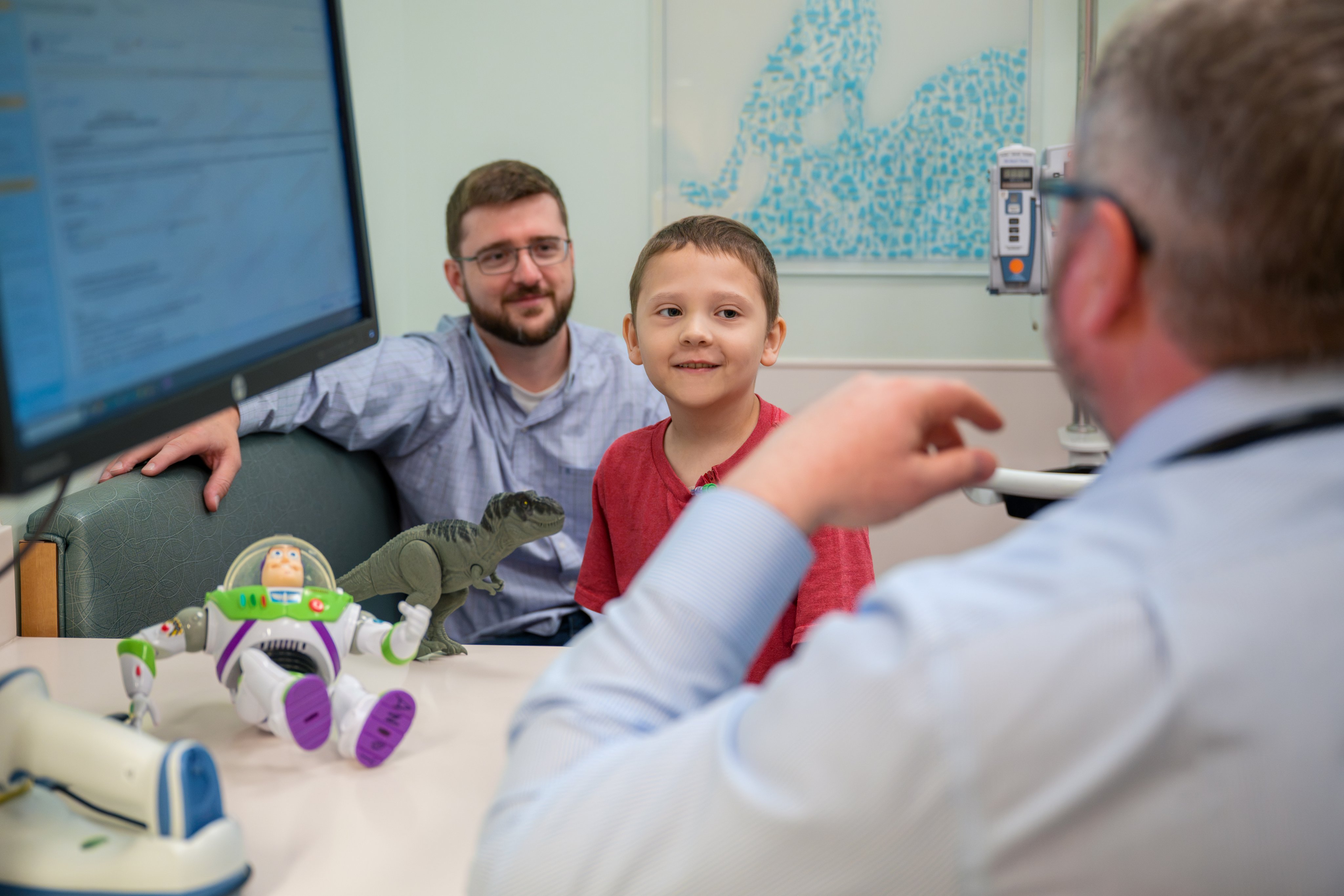
But in a Burkitt’s lymphoma support group Chelsea joined, she remembered reading about a new treatment. She found the article, just published in the New England Journal of Medicine, and brought it to UVA Health Children’s pediatric oncologist Daniel “Trey” Lee, MD.
It wasn’t a perfect study. There were only 3 participants, and they were all adults. But they also all were alive more than a year after the study.
“It’s common for us to have a parent who finds something out there on the internet and bring it to our attention. And I think it’s important to really honestly consider that, because it might actually be the key to victory,” Lee shares.
For Joshua, there wasn’t just one key to victory. His family’s advocacy, his care team’s careful planning, and his own resiliency came together for a cure.
Advocating for a Novel Cancer Treatment
When Joshua was diagnosed, Chelsea began a deep dive into Burkitt’s. “I really dug into trying to learn about the mechanism of it, and how things operate and work. Down the line, it ended up paying off, because I had more understanding of the new treatments.”
Lee and the team express their deep respect for Chelsea’s ability to do this. “There were times we wanted to offer her a job. She’s able to gather information from all kinds of sources, compile it, and come out with one cohesive conclusion. And do so quickly. It’s an amazing skill.”
It made Chelsea an incredible advocate for Joshua.
Her deep dive is what helped her understand the new immunotherapy treatment she’d read about in the New England Journal of Medicine. Immunotherapy teaches the immune system to fight back against diseases like cancer, which normally evade the body’s defense systems.
While Lee hadn’t had experience with this new immunotherapy, he’s long been on the forefront of implementing immunotherapy to fight childhood cancers. He reached out to colleagues around the world who had used one of these drugs in combination with chemotherapy. IIt seemed promising. So, they developed a pediatric dosing protocol.
After treatment started, Joshua’s health started improving. Finally, he acted like himself again. Unlike the chemo which had left him nauseated and without energy, the immunotherapy let him be himself.
The family couldn’t wait for the bone marrow transplant that would represent a true cure, and an end to this challenging journey.
But before he could get his bone marrow transplant, Joshua completed a PET scan. PETs can show cancer cells that are still asymptomatic. And in Joshua’s case, the scan revealed that he’d relapsed.
Lee’s Back Up Plan
After chemotherapy and before the new treatment, there was a short period where Joshua was recovering from the surgery that had removed as much of the cancer as possible.
Because Burkitt’s is the fastest growing cancer in humans Lee knew that if they needed to pivot after the new immunotherapy treatment, they’d need to move fast. He had prepared for CAR T-cell therapy as a back-up. CAR T is another immunotherapy, which uses a patient’s own T-cells to specifically kill the cancer cells. But timing T-cell collection to be far enough after chemotherapy is challenging for Burkitt’s patients. Joshua’s recovery from surgery was the only time healthy T cells could be collected and stored.
When Joshua relapsed, the CAR T was his next option. Others had tried it and most were not successful. So Lee looked closely at Joshua’s tumor – under the microscope. It was full of other immune cells that shut down CAR T cells. He had to get rid of them if this was going to work.
Lee talked to the family and found an approach to help ensure that this, the last shot, would land. In the end, Joshua got to once again be the first in the world to try a cocktail of medications with CAR T to improve its effect against Burkitt’s .
Chelsea joked with Lee that it was time to “throw the book at this thing.” It was a joke, but the sentiment was real. Everyone, especially Joshua, felt they could defeat this. And they knew they weren’t ready to stop trying.
59 days later, Joshua’s cancer was gone. A complete cure was within reach.
One Resilient Kid
The oldest of the Quinterns’ 4 children, 8-year-old Joshua is described by his medical team as brave, and the type of kid who can pick himself up and keep marching on. “He never meets a stranger,” Chelsea says. “He just really enjoys getting to know people and them getting to know him.”
Through his treatment, he kept his relationships with his siblings alive. Including forging a new one—Joshua’s youngest brother was born as the family combatted his lymphoma together.
He also kept his mind sharp, working with the hospital educational team to read, work on math, and do arts and crafts. These activities reminded the family that there was life outside of the hospital.
Stronger with Family
When it was finally time for Joshua’s bone marrow transplant, his whole family was tested to find the best match. Siblings have a 25% chance of being a full match. Parents are usually a 50% match, not ideal, but still doable.
For Joshua, his little brother, Caleb, ended up being a 10 out of 10 match, a truly perfect transplant candidate. And even though Caleb was only 2 years old, his donation ended up being a notably large sample.
The bone marrow transplant was the conclusion of Joshua’s Burkitt’s battle. The Children’s Hospital of Philadelphia (CHOP) hosted a victory ceremony. But the family agreed it didn’t quite feel right.
“The battle was fought at UVA Health Children’s,” Chelsea says. “That was where some of our hardest but also our best moments were.”
Supporting Families Through Cancer
Chelsea and Jason speak highly of the UVA Health Children’s care team that helped their child. Not just because they got a good medical outcome, but because they felt cared about and supported throughout their journey.
“You’ve got nurses that stay after and play video games with your son or bring in little lights to decorate for different holidays. They know your child, they know you, and they’re an additional support,” Chelsea remembers.
The family has now become that support for others. Lee is unequivocal in his admiration for the advocacy work the family has embarked on. Obviously, they were incredible advocates for their son, but since it has grown beyond that to include “all the kids in the world, really, with this disease. They’ve started a foundation to increase awareness with a large social media presence. People all across the world are hearing Joshua’s story.”
Because of this advocacy, doctors with cases similar to Joshua’s have started reaching out to his care team to learn if it might be an option for their patients. Because of one boy, the possibilities for a minimally toxic effective treatment have created international impact, and it’s only the beginning.
Article Topics