Multidisciplinary Approach to Type 3 Laryngeal Cleft Repair
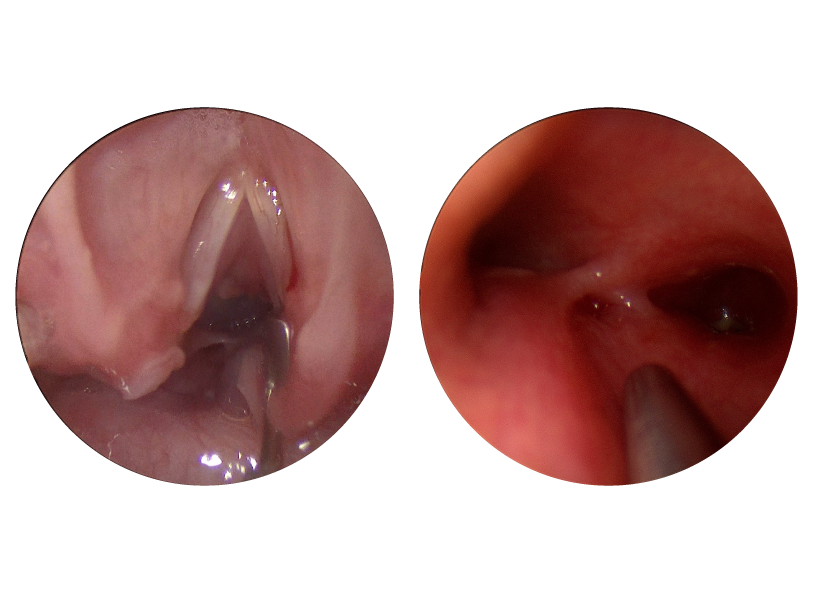
Severe laryngeal clefts are extremely rare. These congenital malformations are so infrequently seen that even otolaryngologists who focus on complex airway repairs may only see 1 in a year. As surgical techniques advance rapidly in this field, the approach to these conditions is ever evolving.
At UVA Health Children’s, a multidisciplinary team recently performed the institution’s first type 3 laryngeal cleft repair. This repair is performed at very few children’s hospitals in the country. Ariana Greenwell, MD, an assistant professor of otolaryngology, led the multidisciplinary team. She shared why this was the right case, what safeguards they put in place before the procedure, and how the team came together to deliver a positive outcome for their patient.
Why This Case
“This child was diagnosed at birth,” Greenwell shares. “She was very medically complex because of her underlying cardiac disease.” Before they could repair the cleft, the heart surgery and its recovery had to come first. And due to severe reflux issues, also a gastrostomy.
The family already had multiple other children at home. And even under the best circumstances, they were spending much of their baby’s early life at a hospital. Traveling to another children’s hospital with previous experience repairing these rare birth malformations would present undue hardship to a family already overcoming a lot.
Staying in the area, where they had support and could stay united, was in the family and patient’s best interest. After achieving a good outcome with their child’s heart surgery and gastronomy, the family also had a positive relationship with UVA Health Children’s.
Multidisciplinary Team Assembly
Some of the team had already assembled before the decision to repair the laryngeal cleft was made. Greenwell says, “The patient’s reflux meant the GI team was involved before they would have been in the outpatient world, and they really facilitated control of her reflux.”
Pulmonary was also on board. “They were involved in recommendations for inhalers, chest PT, positioning, and ventilator settings,” Greenwell shares.
But the intricacies of the actual surgical procedure also needed to be accounted for. Greenwell had a trusted second set of hands in Vanessa Torrecillas, MD. “I engaged one of my adult airway surgeons. She operates in the airway all the time, so she helped with planning.”
Keith Bachmann, MD, a pediatric orthopedic surgeon, helped harvest a tibial periosteum, a critical piece of tissue needed for the repair. The standard places for getting this piece of tissue weren’t possible due to the prior sternotomy and the limitations of working with an extremely young patient. The tibia made the most sense, and with Bachmann’s orthopedic expertise, they could ensure that this piece was removed without impacting the growth plates.
But a lot of the planning came down to pediatric surgery and otolaryngology. Pediatric surgeon Lily Cheng, MD, worked with Greenwell to determine surgical needs for a smooth operation.
Preoperative Planning
The location of the tracheal repair meant that there needed to be a way to ensure continued oxygenation. In most laryngeal cleft repairs, a cardiac bypass during the procedure is how this is accomplished. For this patient, though, her unique medical circumstances precluded this solution. She'd already had a sternotomy and didn’t have normal cardiac anatomy. Cheng and Greenwell instead evaluated ECMO.
“But going into an artery has a stroke risk,” Greenwell says. Cheng talked to the ECMO perfusionist to evaluate a VV- ECMO approach to reduce risk. This option was determined to be the best for the patient.
PICU Team
One of the most important parts of the planning was thinking about recovery. “That’s why I think engaging the PICU team early and explaining what the surgery is was so important," Greenwell shares.
In addition to making sure the PICU team understood the surgery, the surgical team also took the time to understand the needs of the critical care team. Thinking about how the patient would be moving or not moving during recovery, the need for weaning sedation, and how to balance the patient’s existing medical needs and post-surgical recovery needs shaped some of the decisions made early on.
Taking Time for Contingency Planning
When it’s a rare condition, there is limited knowledge of the potential complications. So, the team made sure they planned for every possibility they could think of.
“The extensiveness of the planning made it so that, yes, things could go wrong. But we had multiple backup plans,” Greenwell says.
And a big part of that planning was working through the steps with each specialty. “I think that’s what made this piece so successful,” Greenwell explains. “We made this environment where everyone felt they could ask a question.”
With each question, the team took the time to revisit possibilities. “It forces you to go through it all again. Every meeting brought up one more question.”
An atmosphere of question-asking and information-seeking that centered around the patient created a team that was ready for every situation and fully aligned on strategy.
The Outcome
Everyone’s willingness to work, innovate, and their dedication to their specialties and the patient came together on the day of the procedure. From the high-risk pediatric nursing team coming in early to surgeons finishing their pieces of the procedure before they went to their clinic hours.
They’d prepared for everything that could go wrong. “It went off without a hitch,” Greenwell says. A smooth recovery included “no breakdown, no scarring, no decannulation events. It exceeded my expectations and highlights what we can do.”
For the patient and their family, it’s a positive outcome at the end of a very long tunnel. But for the team, it’s just the beginning. The partnerships found while navigating through this procedure will open new pathways of treatment for patients with similar challenging conditions.