Expanding Parent-Child Interaction Therapy Access in Virginia
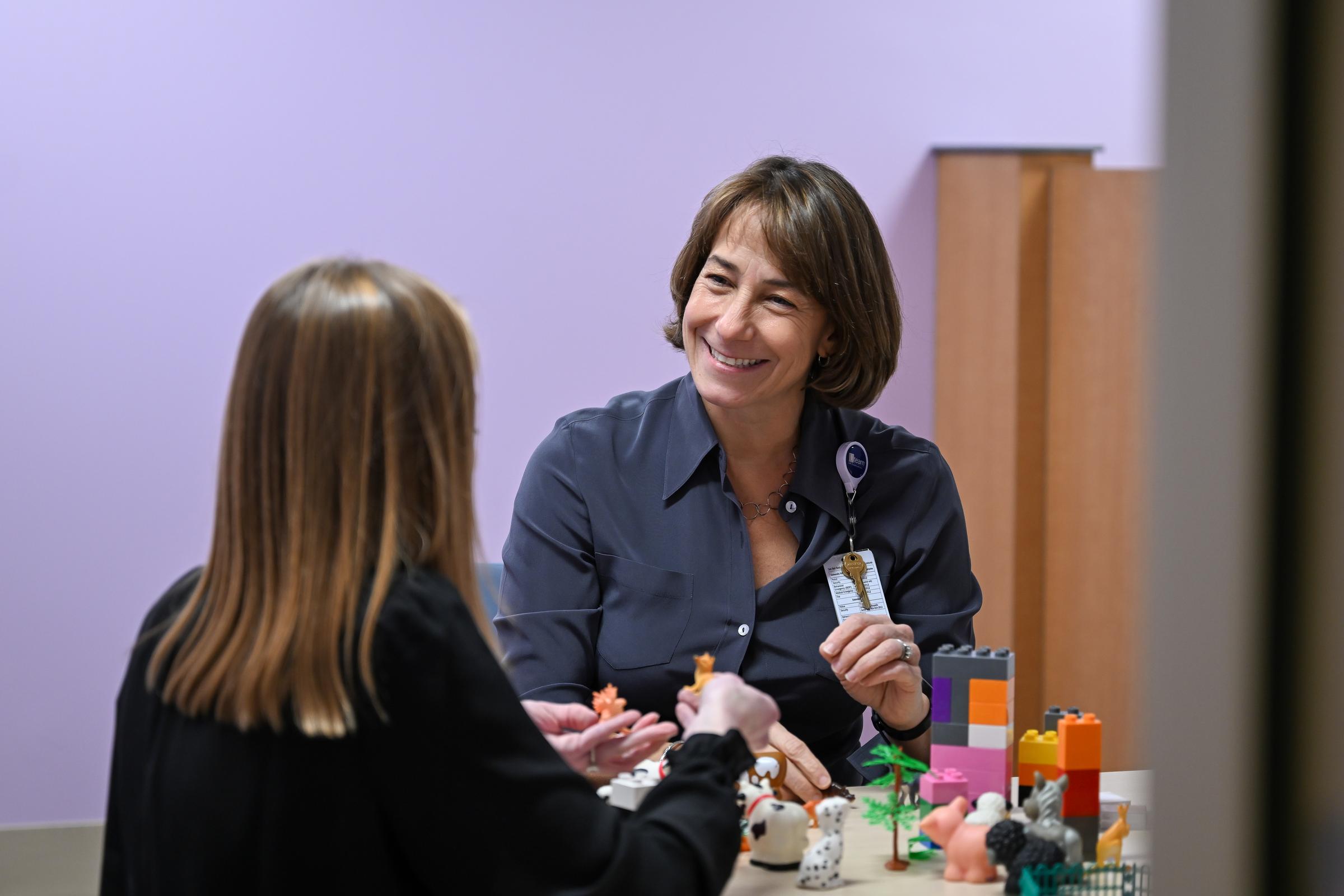
More therapists at UVA Health Children's and throughout Virginia now have access to an effective form of play-based therapy for young children, thanks to efforts by pediatric psychologist Alisa B. Bahl, PhD.
Bahl trained in Parent-Child Interaction Therapy (PCIT) early in her career and has been offering it as part of her practice since she joined UVA Health Children’s 13 years ago. But with the opening of the Neurodevelopmental and Behavioral Health Clinic, she now has a highly valued commodity: space. With this added space for therapy sessions, more patients can be seen.
And in training more therapists in the art of PCIT and showing its merits, UVA Health Children’s is helping expand the intervention’s reach — ultimately helping more children achieve better mental health outcomes.
A Proven, Play-Based Therapy with Decades of Evidence
PCIT was originally developed in the 1970s as an intervention to help children between the ages of 2 and 7 who struggle with frequent tantrums, aggression, defiance, or emotional regulation difficulties. Today, it’s grounded in more than four decades of research and differentiates itself from other interventions with its live coaching session model. In fact, PCIT consistently ranks among the top interventions for young children with disruptive behavior disorders, trauma exposure, and caregiver relationship issues.
In PCIT sessions, caregivers participate in live coaching sessions conducted by a trained therapist during play-based interactions. Therapists observe and coach caregivers from a separate room with a one-way mirror using an earbud and a microphone. Through this framework, caregivers learn to employ positive parenting skills and develop the necessary skills and confidence to support their child.
The challenge, Bahl says, has been providing access to this evidence-based therapy to the multitude of families who need it. Certification for therapists is time-intensive, requiring 40 hours of didactic learning, followed by a series of reviews and consultation calls to ensure therapists are delivering the therapy with integrity. Additionally, this type of unique, tailored intervention typically uses a specialized space that allows therapists to observe a parent-child dyad from behind a one-way window or through real-time video.
But Bahl emphasizes that while these things are helpful, she understands that many community agencies do not have the resources to create this kind of space. When training other therapists in using this technique, she helps them troubleshoot and find ways to help families with the resources they have right now.
Creating the Right Environment for Specialized Pediatric Care
With the opening of the Neurodevelopmental and Behavioral Health Clinic in December 2024, UVA Health Children’s gave Bahl the opportunity she’d been seeking, affording her not only the ability to increase the number of PCIT-certified specialists but also to see more children and address a broader range of problems.
In addition to therapy and exam rooms, the clinic offers spaces that are calming and easily adaptable to children’s needs. These larger, multipurpose rooms are often especially helpful to children with developmental disorders who may feel anxious or overstimulated in large, busy settings, like hospitals.
A Transformational Grant to Grow the PCIT Workforce
A few months later, at the beginning of 2025, The Jefferson Trust awarded Bahl an $80,000 grant that enabled her to train more specialists — including UVA psychologists, graduate students, and community therapists — to become PCIT-certified therapists and help children and families living in other parts of the state, especially in rural and underserved areas.
“We’re seeing an increase in child mental health concerns that actually preceded the pandemic, and since the pandemic, have skyrocketed even more,” Bahl says. “Part of what we’re trying to do is make sure families and their children are able to get access to good, evidence-based mental health care. Not just folks situated in bigger metropolitan areas, but also those spread across the region who might not otherwise have access to care. We’re trying to do this in innovative ways, and training therapists in these more rural areas is one way to expand the reach of what we’re able to do.”
The grant allowed Bahl to establish a flagship PCIT clinic within the Neurodevelopmental and Behavioral Health Clinic. She now has a team in place, including another pediatric psychologist, Emily O’Gorman, PhD, who’s currently working toward certification to train others in PCIT.
Building a Statewide Network Through Strategic Partnerships
Bahl is active with PCIT International who have partnered with the Center for Evidence-based Partnerships in Virginia (CEP-Va) to train PCIT-certified therapists in several community agencies across the state. CEP-Va is a collaborative, state-based initiative that works to increase access to quality behavioral health services. In addition, Bahl has partnered with ReadyKids, a local non-profit, to provide training and consultation for their counselors, further expanding children's to access to PCIT.
In addition to providing training for therapists at regional sites, the Jefferson Trust award has enabled Bahl to train UVA Health Children's therapists to provide PCIT at UVA Health Children’s. O’Gorman became a Certified PCIT Therapist at UVA, and four Ph.D. students in UVA's Clinical & School Psychology program are completing their training and providing clinical care while on rotation in the Neurodevelopmental and Behavioral Health clinic under Bahl’s supervision.
“I’d like to continue to expand access to PCIT at UVA Health Children’s by training other providers within the health system and by bringing in new providers, because we have the rooms that are ready to go and we have the equipment in place,” she says. “The next leg of the project is for UVA to serve as the flagship clinic for the state, so that we can train others and expand the workforce across Virginia.”
How Families Can Access PCIT at UVA Health Children’s
At UVA Health Children’s, Bahl and her team accept referrals from developmental pediatricians within the health system. And starting this year, they plan to expand referrals to community pediatricians as well. Bahl encourages any family looking to strengthen their parenting skills or learn more ways to manage challenging behaviors, tantrums, or emotional regulation to request a referral for PCIT services from their pediatrician or primary care provider.
A unique feature of PCIT is its indeterminate length. While it typically runs between 12 and 16 weeks, some families complete it more quickly, while others require more time. What’s vital is the early intervention piece, Bahl explains. “Children don’t outgrow behavior problems as they get older,” she says. “Instead, the problems snowball. So, early intervention has the best outcome because caregivers can change the direction before behavior issues become more challenging.”
Metrics that determine success in PCIT include weekly evaluations, family reporting, and behavior rating scales. Parenting stress is also a major factor that’s measured, Bahl says, adding, “We want to make sure that parenting stress is improving as caregivers become more confident in using these skills to manage their children’s challenges.”
Evolving PCIT to Meet the Needs of More Children and Families
Over the past 40 years, PCIT has evolved to help with additional behavioral challenges. For example, there are now adaptations of PCIT for children with a history of trauma, selective mutism, and autism. Adaptations have also been developed to help children outside the targeted 2-7 age range.
“PCIT was designed for kids in a specific age range, and that’s the area with most of the research so far,” Bahl says, “but kids who are both younger and older can benefit from the intervention when it’s modified a bit to meet their needs. We can change the dynamics of play to meet children where they are.”
Ultimately, the goal of PCIT is to help children thrive with their families. With the resources now in place to expand access to the therapy, Bahl says she has renewed purpose: “For many years, I was providing PCIT by myself. Growing this work has been reinvigorating for me. It’s reignited the joy.”
Article Topics