ECMO Support After Lung Transplant – Antonia's Story
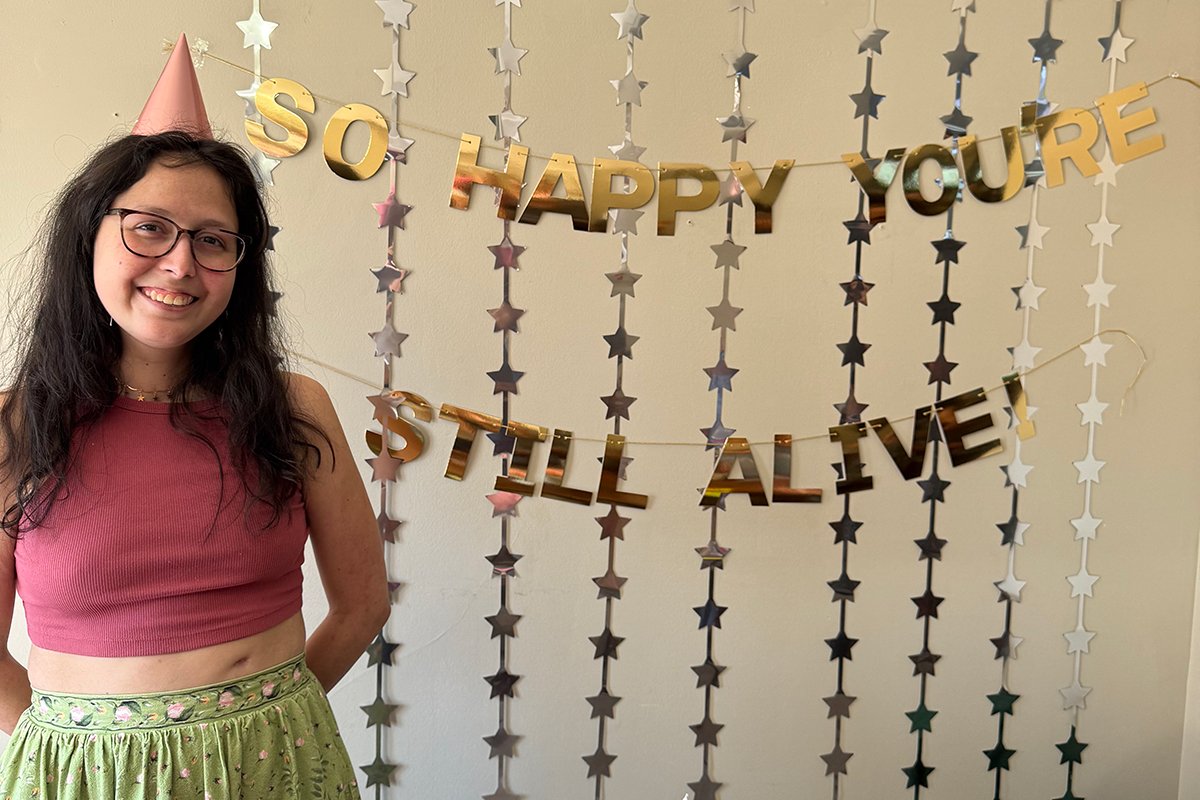
For Antonia Hernandez Ortiz, her journey with ECMO began in 2022 with a diagnosis of pulmonary artery hypertension. A kind of high blood pressure in the arteries of the lungs, pulmonary hypertension lowers how much oxygen gets into your blood and makes it harder for your heart to pump blood properly. Over time, it can lead to heart failure.
For two years, her treatment was intense. "I was on 24/7 treatment, with it through an IV port in my chest," recalls Antonia. But, by the summer of 2024, "It got to a point where my body couldn't keep up with the treatments and the disease progressing," she says. "And then my doctors had that hard conversation with me of, 'We're running out of parachutes, we need to reconsider transplant.'" Antonia was put on the lung transplant list and had her lung transplant at UVA Health.
Extracorporeal membrane oxygenation (ECMO) came into play to help Antonia recover after her lung transplant.
What is ECMO?
"It's similar to the heart-lung machine that we use during heart surgery. And we can set it up to support both the heart and lungs or just the lungs, depending on what the patient needs," says Jared Beller, MD, a heart surgeon at UVA Health.
You might need ECMO if you have:
- Trouble getting enough oxygen into your blood
- Trouble getting enough carbon dioxide out of your blood
- Trouble pumping enough blood around your body
ECMO is as a powerful tool that does the work of the heart and lungs so they can rest. It's often used as a support to help patients survive while they wait for a transplant or recover from a major surgery. "We can expect to see some really dramatic recoveries in some patients, whether that be recovery of their heart or lung function over time, or recovery in the form of a transplant with a new organ," Beller says.
The process follows three main steps:
- Small tubes are placed in your large blood vessels to bring blood into the ECMO machine
- Fresh oxygen is added and waste is removed from the blood
The machine warms the blood back to body temperature and pumps it back into the patient.
The Challenges of Lung Transplant Recovery
Antonia remembers waking up and seeing a large machine nearby. "I woke up on ECMO. I'm not sure if it was right away. I know I'd been in and out for a couple of days after the transplant, but when I fully came to, I remembered seeing a big machine and seeing or feeling rather a heavy, warm tube next to my head."
She found her recovery experience frustrating at times, especially because of the tubes. "I couldn't move my head from side to side... and it was just warm all the time, because it's oxygenating my blood," Antonia explains.
Recovery also meant starting physical therapy while still connected to the machine. To make movement easier, the staff would wrap the extra coils of the ECMO machine into a "crown or halo" on Antonia’s head. Despite the discomfort, Antonia stayed positive, thinking, "It's not forever. It's going to be over soon. We're going to get better. We're going to get through this."
UVA Health's adult ECMO team was named a Platinum Level Center of Excellence, the first in Virginia.
Support From the ECMO Team
During this difficult time, the nurses and team members at UVA Health provided needed support. Since Antonia couldn't speak, they would communicate by texting words on a phone. "They would just tell me words of encouragement," Antonia recalls. "They would push my hair out of my face and make sure that I felt comfort when I didn't have family around me".
The support extended to Antonia’s family as well. Social workers arranged for Antonia’s parents to stay at a nearby hotel so they could be close by during the long ICU stay. "To be able to have at least one family member here with me, almost every single day while I was in the ICU, was honestly so helpful," Antonia notes.
Beller notes that helping patients get through to a successful recovery is something the team take takes to heart. "Patients that are supported with ECMO go through a long journey, but when they come out on the other side and are able to make it out of the hospital, recovering and going home to their families, it really is such a meaningful experience for our entire care team. And ultimately, that's why we're here every day: to get patients through one of the most difficult times in their lives and get them back to their families and doing the things that they love doing."
After ECMO & Recovery
After months of recovery, Antonia was finally able to return home and settle back into a routine. The transition involved spending time with family, running errands, and reuniting with pet cats.
Today, Antonia is back to her busy, active life. "Now, I have a job that I go to every single day and I'm involved in extracurricular activities, like the local theater and stuff," Antonia says.
Thinking back on her experience, Antonia says, "ECMO has definitely had a huge impact on my life. It's definitely changed my life for the better, because it had a huge part in my recovery process after transplant. If it's needed, it's the best option for you. It's helping your heart, helping your lungs, helping your entire body get the oxygen it needs in order for you to continue your recovery. It was a necessary part of my recovery, and I'm glad that I had it, honestly."