Dr. Friel’s Story: 6 Key Decisions in the Colon Cancer Journey
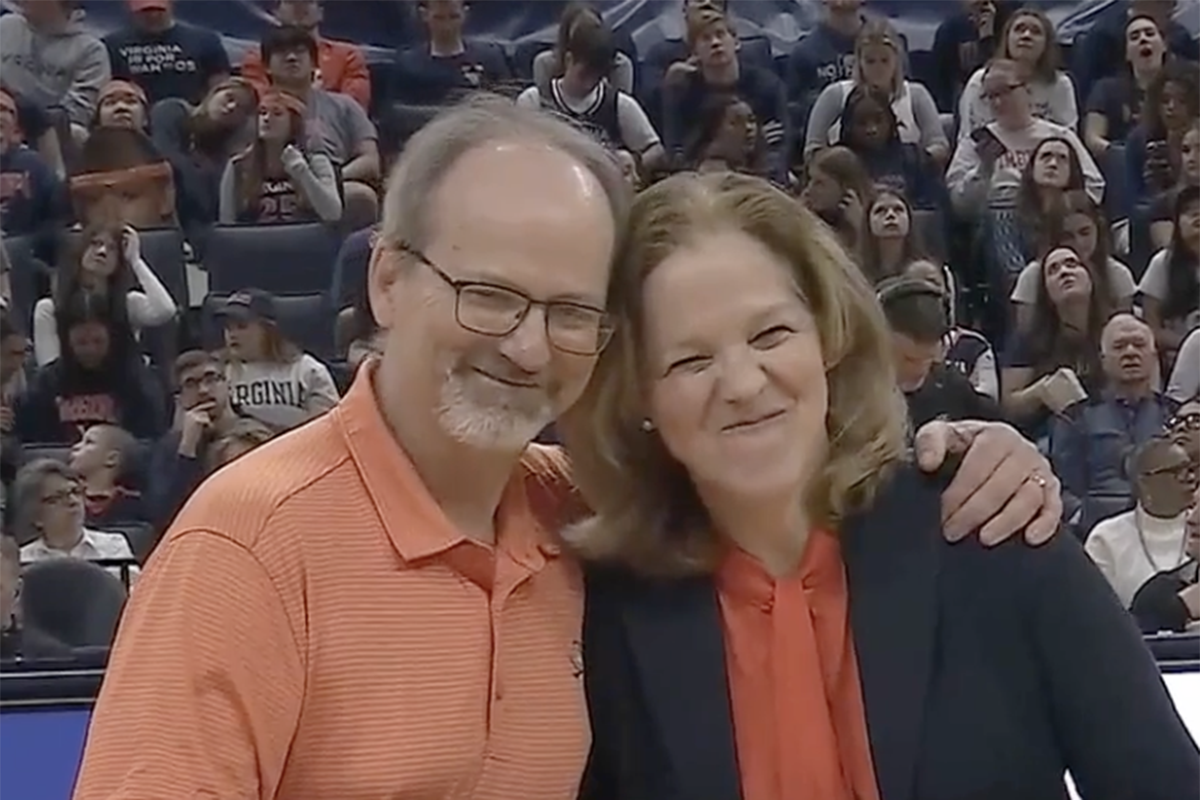
Charles Friel, MD, was honored at a UVA basketball game by Leigh Cantrell, associate director of clinical affairs for UVA Cancer Center.
As section chief of colorectal surgery at UVA Health, Charles Friel, MD, was no stranger to the colon cancer journey. But to truly understand what battling cancer is like, lived experience is the greatest teacher. Recently, Friel himself was diagnosed and went through treatment for colon cancer at UVA Health.
As he told his story, Friel shared 6 key decisions that shaped how his journey unfolded. These turning points illustrate the choices we all have in our own healthcare. Even for a doctor, the choices were difficult and sometimes uncomfortable. But his story also includes moments of empowerment and support.
In his own words, Friel describes his journey and these most important moments.
Decision #1: Making Time for Colon Cancer Screening
I have a history of ulcerative colitis. I was in my late 50s and I had not had a colonoscopy, I'm embarrassed to say, for about 10 years. I was not feeling bad. I had no symptoms, nothing at all. Like many men in their 50s that are working hard, I wasn't seeing my doctor on a regular basis.
I got my colonoscopy largely because my wife reminded me that I was way behind. I'm in the right age bracket for colorectal cancer. I scheduled an appointment with my doctor and got my scope
Results of that Decision: I was diagnosed with colorectal cancer. Thank goodness I listened to my wife. My treatment was just surgery. I didn't need any additional chemotherapy. I didn't need any additional radiation. That really did expedite my recovery. I think if I had waited much longer, it would've been more advanced and difficult to treat.
Decision #2: Where to Get Care
Truthfully, I didn't even hesitate. I knew who I wanted to be involved in my care. I've been working here for 23 years. I've made a lot of friendships with a lot of people in this field. I knew them personally, and I knew they were all excellent doctors.
Tracy Hedrick, MD, chief of general surgery, is a partner of mine for many years. I first met her when she was an intern, and now she's been working here side by side with me for the better part of 15 years. I knew from the start that she was going to be my surgeon.
Results of that Decision: The operation went very well. it was a completely successful procedure. I'm now 2 years out, free of disease.
Decision #3: Being Upfront With the Doctor
I made my feelings very clear with my surgeon, Dr. Hedrick. We talked about the different options that I had. And I did have some extra insight given the fact that I do a lot of the surgery myself, but I was very clear about what my goals and what my expectations were. My first and foremost goal was to be cured, but I was also thinking about the impact of my treatment plans. I wanted that to be tailored to my needs.
Results of that Decision: I was anxious about the surgery. I was anxious about the outcomes. I had some insight into what could not go so well, and that was scary. But I also had great confidence in the team that I was working with, and I knew that they were going to give everything of themselves and that I was going to really get top-notch care.
Decision #4: Accepting the Doctor’s Advice
We talked about the need for a temporary ileostomy, which was a bag on my side. Obviously, like all patients, I wasn't really excited about that. That was the one non-negotiable part of the discussion with Hedrick. She said, "I'm going to do that," and I said, "If I were you and I was my own surgeon, that's exactly what I would do as well."
Navigating a Colon Cancer Diagnosis?
At UVA Health, we're here for you every step of the way.
Results of the Decision: I did have an ileostomy created, and that was an extra thing for me to learn and put up with.
Decision #5: Accepting Help
One thing I got a great appreciation for was the quality of our nursing teams, especially the nursing teams at night. They taught me how to care for my ileostomy. I had all the resources that I needed.
Results of the Decision: I was able to make a pretty rapid recovery. Within about a month, I was seeing patients. I was operating. Even though I had an ileostomy bag, I was out with my friends playing some tennis. My greatest joy that whole time was I took the time to walk the entire Rivanna Trail. That was my daily exercise, and I did that all with an ileostomy.
Decision #6: Moving Forward With Care & Empathy
When I was diagnosed with colorectal cancer, it did give me a bit of a new perspective. I had to flip the script and go from doctor to patient. Fortunately, my operation went really well and I had my ileostomy reversed several months later.
Results of the Decision: I like to think I was empathic before. But now that I've gone through this experience myself, I'm even more acutely aware of the issues my patients are dealing with.
Subscribe to Healthy Balance
Get timely health and wellness tips from UVA Health experts. Plus, stories that will move you.