More Than Being "Double-Jointed": Understanding Ehlers-Danlos Syndrome
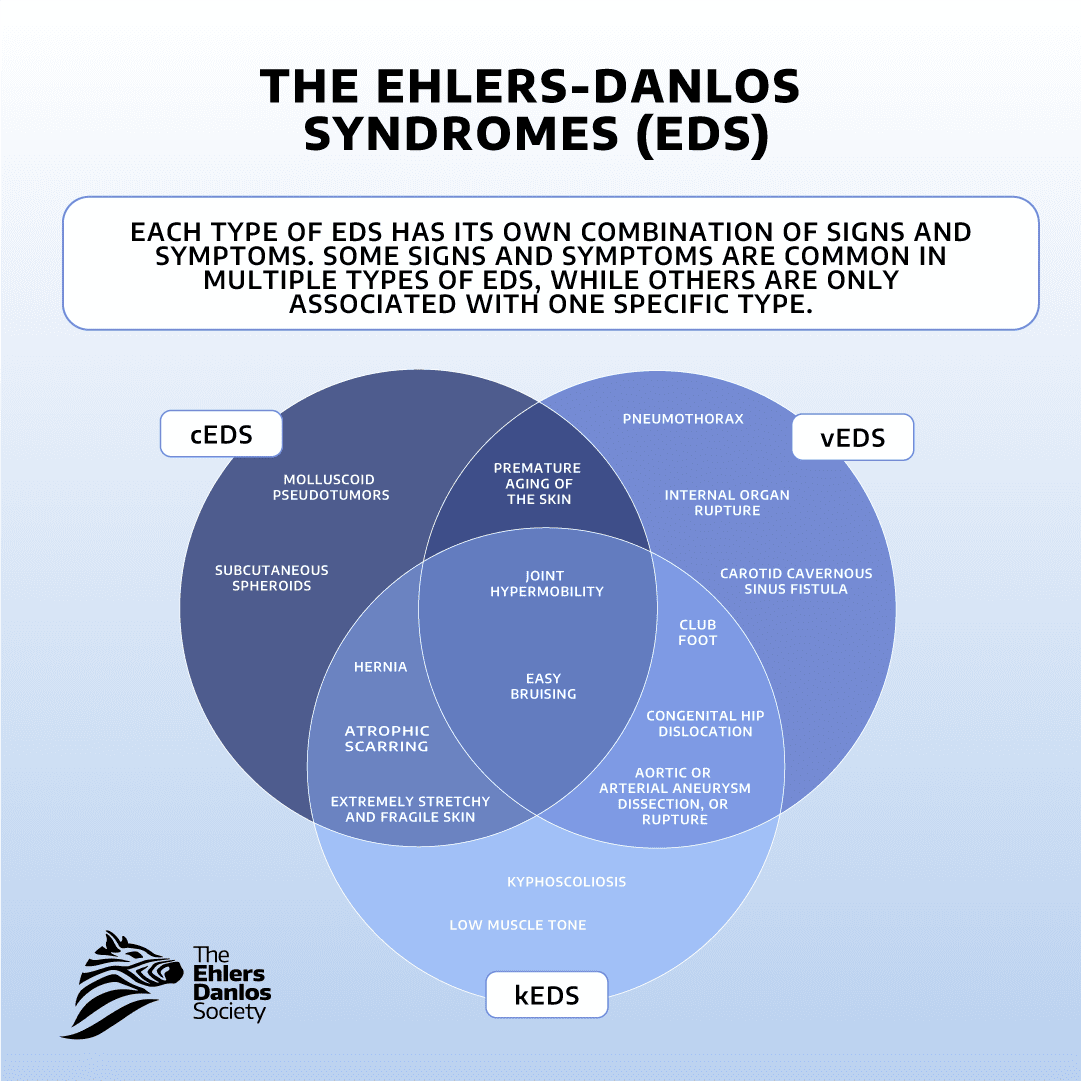
Venn diagram showing different types of Ehlers-Danlos syndrome and where symptoms overlap
Guest Author: Amalie Kathrin Parr
Did people call you “bendy” as a kid? Can you pop your joints in and out on command? Maybe you’ve also had unexplained chronic pain or symptoms that don’t show up on tests. If you've experienced these and feel like you've spent years searching for answers, you may find it helpful to learn more about hypermobility spectrum disorder (HSD) and the different types of Ehlers-Danlos syndromes (EDS).
What Is EDS?
While you might think you have heard more about EDS recently, what you were likely hearing most about is the hypermobile type of EDS (hEDS). Because hEDS ranks as the most common subtype, media coverage often focuses on it. But there are actually 13 total subtypes of EDS listed by the Ehlers-Danlos Society.
The other 12 are very rare. For most types, we can test for them by looking at your genes. They have specific genetic markers. As a result, people often call them the rare or monogenic subtypes of EDS. These include vascular EDS (VEDS), classical EDS (cEDS), and classical-like EDS (clEDS).
In 2017, researchers set the specific diagnostic criteria for hEDS. They noted that some patients didn’t fully meet the criteria but still showed similar symptoms. When that happens, clinicians use HSD as the diagnosis. With that in mind, HSD appears in discussions and research about EDS so that clinicians can continue learning and update diagnostic criteria. That way, no patient gets left without care.
The Right Diagnosis is Important
A recent post from the Collagen Advocacy Network, an advocacy group for patients with rare types of EDS, highlighted a serious issue: providers sometimes treat patients with rare types as if they have hEDS, even when those patients have a different diagnosis. That mistake can lead to symptoms getting worse, long-term health issues, and even create life-threatening risk.
Because medical education has historically overlooked EDS and HSD, there is still a lot of work to do to make sure clinicians have the information they need to diagnose and treat their patients properly. Learning what these conditions are, and what they aren’t, is the first step toward getting the right care.
EDS is Different Depending on Type
People often connect hypermobility with EDS, but not every type of EDS includes it. In the types that do include hypermobility, it’s only a small part of a much bigger picture.
Each EDS subtype has its own list of features that clinicians must see to diagnose it. The International Consortium on Ehlers-Danlos Syndromes and Hypermobility Spectrum Disorders sets these criteria. The consortium acts as an independent working group of medical professionals and experts who develop management and care guidelines for all types of EDS and HSD.
Every patient’s experience with EDS is also different. That means that it’s important to work with healthcare providers who are familiar with EDS.
For example, hEDS often travels with other conditions. Many people with hEDS also have postural orthostatic tachycardia syndrome (POTS), which affects heart rate and blood pressure. Many also face immune system and digestive problems, such as mast cell activation syndrome (MCAS).
How is EDS Diagnosed?
Patients can’t rely on one specific type of doctor or one single test to confirm every kind of EDS. That explains why diagnosis and adequate treatment often take so long.
Doctors begin with a detailed personal and family history and a thorough physical exam. They also look for red flags in personal and family history, such as organ rupture, aneurysms, easy bleeding, and cleft lip or palate, to decide whether genetic testing for a rare EDS type makes sense.
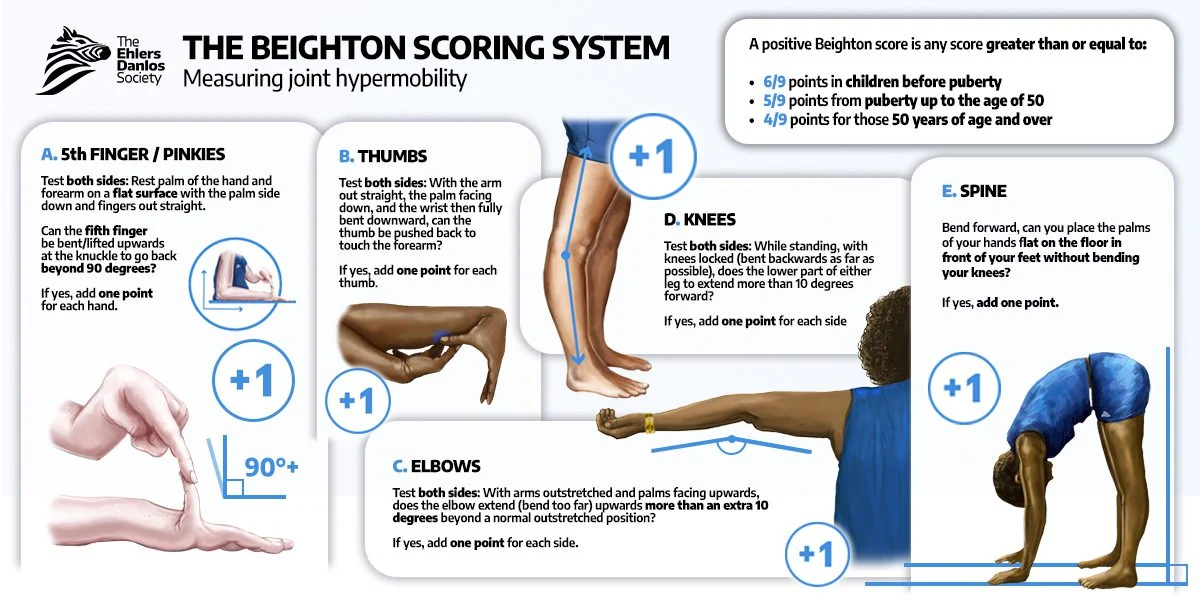
Providers often use the Beighton score to measure joint hypermobility. This quick 9-point test checks how far joints like your pinky fingers, elbows, knees, and spine can bend. The Beighton score helps screen for several connective tissue disorders. But it has limits: it only looks at a handful of joints, and it can’t spot different types of EDS from another. So we also look at the patient’s family and medical history before we make a diagnosis.
For most EDS types, genetic testing can confirm the diagnosis. Hypermobile EDS is the exception, so the diagnosis is based on detailed history and exam. It’s also important to rule out other conditions. If we suspect vascular EDS (VEDS), we need to quickly test for it to avoid life-threatening issues.
Living With EDS: Treatment and Management
There isn’t a cure for Ehlers-Danlos syndrome, but getting effective care can still help. The goal of treatment is to manage symptoms, prevent complications, and improve your quality of life. Because EDS affects so many body systems, our team includes several specialists who work together on a plan built around your specific EDS type and your care needs. Treatment can include:
- Physical and occupational therapy to strengthen muscles around unstable joints and protect joints during daily activities
- Pain management for chronic pain
- Monitoring the heart and blood vessels when needed
- Genetic testing for diagnosis, and family planning guidance
- Surgery to repair joint damage from hypermobility and correct congenital or early onset skeletal deformities
- Care for related conditions like POTS, MCAS, and digestive symptoms (especially common in hEDS)
- Wound management that uses special techniques for wound closure and continued healing (especially important for rare types like dEDS and cEDS)
Just as important, you also need practical, everyday knowledge: how to pace your activity, protect joints, manage symptoms as they appear, and advocate for yourself. Many people with EDS discover that the right support improves not only symptoms but also how they understand and relate to their bodies.
EDS Care at UVA Health
Patients living with EDS can often move from specialist to specialist without anyone ever seeing the full picture. UVA Health is home to one of the few dedicated EDS programs in the country and is committed to helping solve this problem. At UVA Health’s EDS and Hypermobility Disorders Center, our team cares for children and adults with EDS and hypermobility spectrum disorders. They coordinate across specialties such as genetics, cardiology, physical therapy, and more.
Dacre Knight, MD, leads adult care and Ina Stephens, MD, leads our pediatric EDS care. The center focuses on personalized evaluations and treatment plans centered around the whole patient, not just a single symptom.
If you've spent years searching for answers, we are ready to listen. To learn more or to inquire about an evaluation, visit UVA Health’s Ehlers-Danlos syndrome care page or talk with your primary care provider about a referral.
Resources We Recommend
- UVA Ehlers-Danlos Syndrome Inaugural Research Symposium
- Bendy Bodies Podcast ft. Dr. Dacre Knight and Dr. Ina Stephens
- Ehlers-Danlos Society
- Dysautonomia International
- Collagen Advocacy Network
- Sarah Cohen Solomon, MD, FAAP (website): The Bendy Pediatrician (social media)
A note on what's ahead: the international criteria used to diagnose EDS were last updated in 2017, and a global team of experts is now working on a major revision expected to be published in late 2026. The aim is to make diagnosis faster, clearer, and more inclusive. Welcome news for the many people who've waited too long for answers.