Trusting His Heart Again: How Ablation for Afib Helped Bob Get Back on His Bike

Bob Wright poses next to the Grand Canyon. This was one of his stops along his cross-country bicycle tour after an ablation for afib at UVA Health.
Bob Wright spent years cycling back and forth to his job, dreaming of riding across the country one day. The road he traveled in Blacksburg is part of a cross-country bicycle route. As an experienced endurance cyclist, that route called to him. But when Wright developed atrial fibrillation (afib), the dream seemed far away. A catheter ablation procedure for afib at UVA Health changed that.
A Struggle to the Top
Wright, 69, is a retired biomaterials researcher from Virginia Tech. These days, he does engineering work for a commercial hemp processor in Blacksburg. About five years ago, he began experiencing occasional symptoms — sometimes his heartbeat didn’t feel right to him. The feeling was usually short-lived.
Then one day, as he was riding up a challenging hill with friends, he felt a sudden change. “It was as if somebody had turned the ignition off in the car and the car was slowing down,” Wright remembers. His friends quickly passed him while he struggled to the top of the hill.
After some tests, Wright’s primary care doctor diagnosed him with afib. It’s a heart rhythm disorder that can make it feel like your heart is fluttering, skipping beats, or pounding in your chest. Wright says his heart felt “wiggy.”
During afib, the heart’s upper chambers (atria) beat slowly, too fast, or irregularly. They struggle to move blood into the lower chambers (ventricles). Afib often causes fatigue and shortness of breath, which can be mistaken for something else. It can also lead to blood clots and increase the risk for stroke, heart failure, and other conditions.
An athlete since high school, Wright struggled with his diagnosis. Exercise had become a way for him to manage depression, which he didn’t want to treat with medications because of side effects. As the arrhythmia episodes grew more frequent, Wright studied his condition. He read research showing high-endurance athletes can be vulnerable to heart problems. He worried that 45 years of hard training and bicycle racing had taken their toll.
Too Much of a Good Thing
An antiarrhythmic medication didn’t improve the symptoms. Wright’s cardiologist recommended he see UVA Health heart rhythm specialist Kenneth C. Bilchick, MD, about a procedure called an ablation. At UVA Health, the heart rhythm team uses a three-pronged approach to treat afib:
- Anticoagulant medication to prevent blood clots
- Rhythm control to prevent afib symptoms (typically ablation)
- Treatment of conditions that can contribute to afib, like obesity and obstructive sleep apnea
Bilchick prescribed an anticoagulant and recommended an ablation. He appealed to Wright’s engineering brain by showing him charts and heart models and discussing the technical aspects of an ablation. Bilchick agrees high-intensity exercise likely contributed to Wright’s afib.
Feeling Dizzy? Shortness of Breath? Fatigued?
These could be signs of a heart rhythm disorder.
“We think of atrial fibrillation as a disease that becomes more common as we age,” says Bilchick. "There is an exception to that rule, which is men in their 50s and 60s who are into endurance athletics.” Researchers have found there may be an optimal amount of lifetime exercise. Going over that limit with endurance exercise may work against you.
“People like Bob may be victims of this ‘too much of a good thing’ phenomenon,” says Bilchick. “Fortunately, we had a treatment option for him that worked out quite well.” (Despite the research, Bilchick says the good gained from exercise typically outweighs the bad.)
Ablation for Afib
In the weeks leading up to his procedure, Wright exercised very little. He was on a beta blocker that sapped him of his energy. It took 20 minutes to walk 200 yards.
But Wright believes in perseverance and getting the most out of life. He’d recovered from knee injuries, a separated shoulder, and more. He wanted to have the ablation and get back on his bike again.
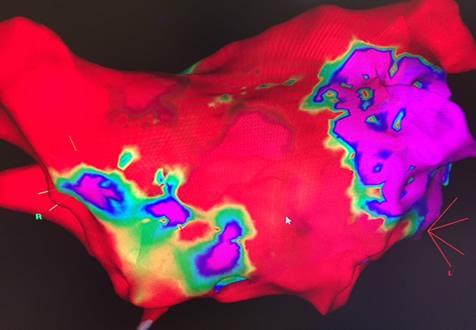
The day before the ablation, Wright checked into the hospital and the UVA Health team created a computerized electrical map of his heart. During the ablation, Bilchick inserted a long IV tube into the vein in Wright’s groin. He then threaded a temporary electrical wire called an “ablation catheter” through the tube and into Wright’s heart. Bilchick used the ablation catheter to cauterize (destroy) troublesome areas in the upper atrial chambers of Wright’s heart. The ablation made those areas stop sending out electrical discharges that caused the afib.
No two afib procedures are the same. Every patient has different areas of electrical disturbance. UVA Health has an advanced suite of mapping and ultrasound tools that make the procedure very high tech. These tools help doctors see how the heart responds in real time. Each ablation procedure can be customized to the patient’s unique needs.
Wright did well after the procedure. He did spend extra time in the hospital because his throat hurt after he woke up. This pain came from the tube anesthesiology doctors put in his airway to allow him to sleep during the procedure. It also took a few weeks for him to get his energy back. “It was two weeks before I felt like I could do much of anything,” Wright says. He then had steady improvements. Wright started a lower dose of beta blocker to get more energy and a low-dose antidepressant.
Heart Rhythm Issues Can Sneak Up: Don’t Ignore the Signs
Ignoring an arrhythmia can stop you in your tracks. Getting help prevents an emergency. See how our experts can help you on your heart health journey.
Trusting His Heart Again
Wright didn’t get back on his bike right away. The ablation was in May 2019 and he took his first ride that August. “My heart that had been my best friend had let me down,” he says. “I felt betrayed by my heart and I didn’t trust it. I was a little afraid to try cycling.”
He took it easy and didn’t start pushing himself again until fall 2020, when he resumed his monthly rides up a local mountain with a 2,000 ft. elevation again. “I was beginning to trust my heart more,” he says. That trust grew. His mental and physical outlook improved. So he set a new goal: He would finally ride his bike across the country.
Cross Country Trip
With his youngest daughter ready to give birth in California, Wright flew out for the arrival of his grandson. And on October 1, 2021, his journey began in Folsom, California. He traveled through Napa Valley, across the Golden Gate Bridge, and down the California coast to Santa Monica. Cycling in California was beautiful and freeing. “The body was working and the depression was gone,” he says. “It was just inexplicably delicious for a person who likes bicycling to be in that situation.”
After leaving Santa Monica, Wright rode through the Mojave Desert and across the southwest. He stopped in San Antonio to help his daughter and her family. They had relocated from California during Wright’s bicycle journey. On March 22, a tired Wright reached the Atlantic Ocean at St. Augustine, Florida. He had cycled 4,300 miles.
Along the way, Wright had raced donkeys down a highway in Arizona and met cyclists from Alaska, Patagonia, and beyond. “When you look at a map, it’s a long way,” he reflects. “But in the midst of it, it was just another day of adventure. It was just being there one day after another and ready for whatever the adventure was. And it was almost always fun.”
Subscribe to Healthy Balance
Get timely health and wellness tips from UVA Health experts. Plus, stories that will move you.
Article Topics
Related Articles