7 Quick Questions with Cancer Rehab Doctor Alyssa Mixon
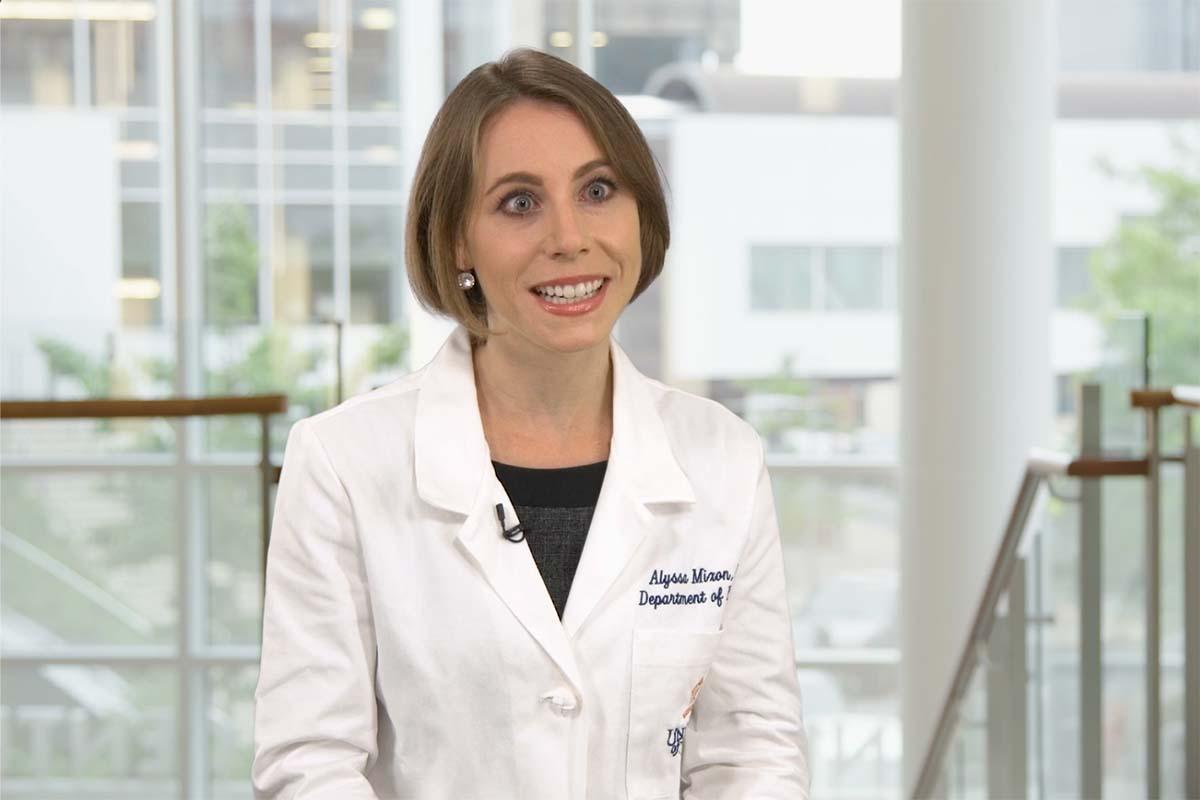
Cancer and cancer treatment often causes pain, muscle weakness, and other issues. As a cancer rehabilitation (rehab) doctor, Alyssa Mixon, DO, MBA, helps patients function better and improve their quality of life. She helps with conditions related to cancer treatment, such as lymphedema.
As a doctor of osteopathic medicine (DO), Mixon can also help patients with manipulative treatments that help with muscle, bone, or soft tissue pain and discomfort.
Meet a Charlottesville-Based Cancer Rehab Doctor
We asked Mixon to answer our 7 quick questions.
1. Why did you become a doctor/provider?
As a cheerleader growing up, I always strived to embody the spirit of believing in and motivating others. I wanted to find a career path that fostered my intellectual curiosity along with my innate desire to help and encourage others. With a passion for the arts and sciences, I found medicine and especially osteopathic medicine to be the perfect blend of treating the patient as a whole: body, mind, and spirit.
My love for teaching, healing, and innovation led me to a rewarding specialty where I have the opportunity to change, build, and improve the quality of life for my patients.
2. Why did you choose your specialty?
I remember as a medical student walking into the therapy gym and seeing a patient who, a month prior, was unable to stand. After being treated by rehabilitation specialists, she was able to walk across the room and hug her children. I realized in that moment, I wanted to be the doctor who helped her achieve these functional goals.
When I mentioned this to my father, he told me about the field of physiatry (also known as physical medicine and rehabilitation or PM&R). Having worked in PM&R research years before I was born, he taught me about how physiatrists optimize a patient’s function, enhancing and restoring their abilities to improve their quality of life with a focus on musculoskeletal and neurologic issues. PM&R doctors work closely with physical, occupational, and speech therapists along with other healthcare professionals in a multi-disciplinary team approach that focuses on teamwork, communication, and progress.
During my time in residency, I was drawn to working with the cancer population. I found myself surrounded by patients who demonstrated determination, resilience, and enthusiasm. I wanted to help make a positive difference in their lives. This led me to pioneer the cancer rehabilitation fellowship program at the University of Pennsylvania.
3. What’s one thing about your specialty that might surprise people?
I think many people are surprised that my medical subspecialty of cancer rehabilitation exists. It is a small but growing field that is very much needed, especially given the increase in survivorship. Cancer rehabilitation is an area of medicine that focuses specifically on the functional and rehabilitative needs of patients with cancer, many of whom are underserved.
This includes conditions before, during, and after treatment like lymphedema, chemotherapy-induced and radiation-induced neuropathies, and other musculoskeletal and neurologic conditions.
4. What’s the most exciting thing/research happening in your field right now?
In my subspecialty of cancer rehabilitation, there are so many opportunities for research. One area that is currently drawing more interest is “prehabilitation.”
Prehabilitation is when we implement a treatment plan for our patients as soon as they are diagnosed with cancer to help increase strength and function prior to receiving treatment. These include exercises, therapy, and massage, as well as cardiovascular and cardiopulmonary training. Several clinical studies have been conducted showing improved outcomes, better tolerance, and reduced functional impairments. This concept focuses on improving patients above their baseline so that after medical interventions, the potential for deconditioning or complications is less than it would be without prehabilitation.
5. Where did you grow up?
I grew up in New England but have slowly made my way down the East Coast, moving to Philadelphia and now Virginia (where it’s thankfully much warmer).
Get Cancer Support
From counseling to pain relief, UVA's team can support you during your diagnosis, treatment, and survivorship.
6. Who is your inspiration or hero?
My inspiration would be my mentor, Dr. Jasmine Zheng, who played an integral role in my cancer rehabilitation training. She helped create the cancer rehabilitation fellowship program I pioneered at the University of Pennsylvania. She also challenged me to research, teach, and network with as well as learn from other healthcare teams.
My heroes are my parents. Both worked in healthcare. My mother started her own marketing business to document the consolidation of the healthcare industry, and my father worked first in physiatry research and then in pharmaceutical research.
Together, they challenged and encouraged me to be the best version of myself. My parents taught me how to appreciate all aspects of medicine, recognizing that its practice truly is an art when it comes to promoting health and wellness.
7. What’s your favorite thing about working at UVA?
The people! From the patients to the care coordinators, my colleagues, trainees, and other healthcare professionals, I feel so welcomed here. Everyone has been helpful in making sure I am able to care for my patients to the best of my ability.
I love having the opportunity to learn from all the different departments at UVA as well. And I love being surrounded by so many experts. It feels more like a family than a healthcare network.
Meet Cancer Rehabilitation Physician Alyssa Mixon, DO, MBA
Subscribe to Healthy Balance
Get timely health and wellness tips from UVA Health experts. Plus, stories that will move you.
![3D Mammography: Earlier Cancer Detection, Fewer False Positives [VIDEO]](https://cdn-assets-us.frontify.com/s3/frontify-enterprise-files-us/eyJwYXRoIjoidXZhLWhlYWx0aFwvZmlsZVwvVEx6QWJVb0dpSm9UYjFxZWQzY20ucG5nIn0:uva-health:_RsorG_nq2M8PQrJUgaWzn_HQldOWcW43nwXlT34_nc)