SoM Scientist Elected to Prestigious American Academy
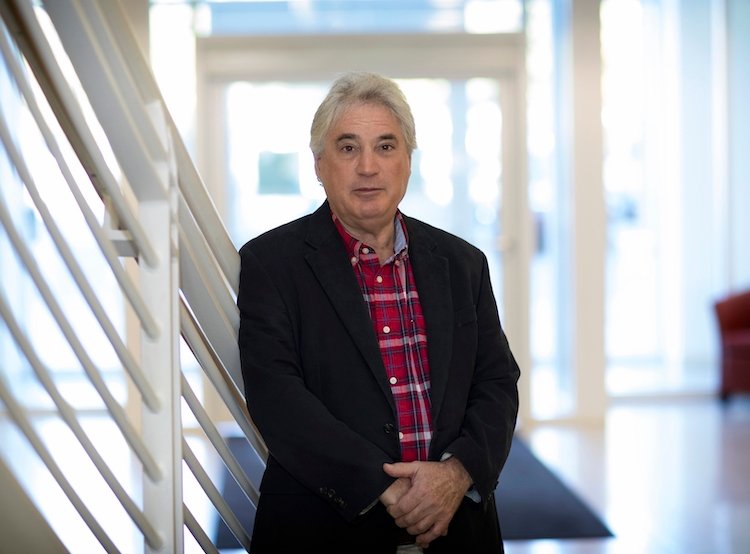
Our Edward H. Egelman, PhD, maps out worlds far too small for even the most powerful light microscopes to see by using cryo-electron microscopy and advanced 3D modeling.
Congratulations to our Edward H. Egelman, PhD, for his election to the prestigious American Academy of Arts & Sciences, a storied group that dates back to the Revolutionary War. He is among more than 250 top leaders in academia, the arts, industry, journalism, philanthropy, policy, research and science to be inducted this year, the nation's 250th anniversary.
“This is truly a great honor for me, but it was only possible due to the students and postdoctoral fellows in my lab and my collaborators from around the world," Professor Egelman said.
The Academy was chartered in 1780 to recognize accomplished people and enlist them to address the greatest challenges facing the young republic. Members have included luminaries as George Washington, Benjamin Franklin, Alexander Hamilton, Ralph Waldo Emerson, Charles Darwin, Albert Einstein, Robert Frost, Margaret Mead and Martin Luther King Jr.
Professor Egelman was recognized for his distinguished career in scientific research. He uses cryo-electron microscopy and 3D modeling to map out worlds far too small for even the most powerful light microscopes to see. His research has primarily targeted protein filaments and protein-DNA complexes. Notably, he developed techniques that enable scientists to determine the atomic structure of helical structures common in nature, such as the hair-like pilli on the surface of pathogenic bacteria.
He was previously elected to the National Academy of Sciences, one of the highest honors a scientist can receive, and is an elected Fellow of the American Association for the Advancement of Science, the Biophysical Society, the American Academy of Microbiology and the European Academy of Microbiology.
Along with Professor Egelman, another UVA professor, James N. Galloway, PhD, was inducted into the American Academy as part of this year's class. Professor Galloway performed pioneering studies on acid rain in the 1970s and played a key role for more than 30 years in the study of acid rain’s effects on native brook – Virginia’s only native trout species – and on southern Appalachia. He most recently focused on maximizing the use of nitrogen for beneficial purposes, such as food production, while minimizing its harmful effects on the environment. Congratulations to him as well!