Tavapadon Ushers in the First New Parkinson’s Drug Class in Half a Century
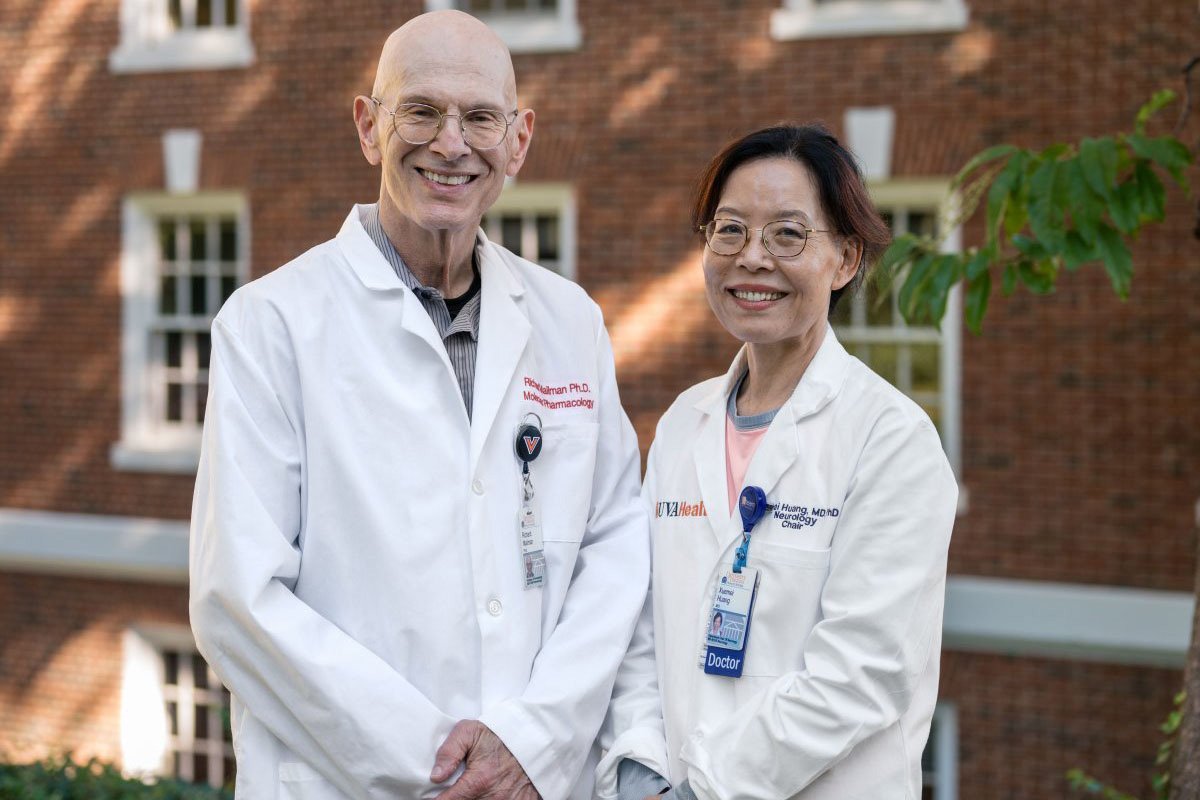
Richard Mailman, PhD, professor of pharmacology and neuroscience, and Xuemei Huang, MD, PhD, chair of the UVA Department of Neurology
In 1960, scientists made a breakthrough discovery: The disabling movement impairment in Parkinson’s disease resulted from the progressive death of dopamine-producing nerve cells.
Research advanced at a rapid pace, and by the late 1960s, levodopa (a dopamine precursor) transformed care by replacing lost dopamine. Dopamine agonists quickly followed. Scientists then distinguished two major families of dopamine receptors, D1 and D2.
Because all of the early drugs primarily activated the D2 receptors, the prevailing view became that D2 played the major role in Parkinson’s while D1 had little clinical value.
That changed in September when the FDA approved Juvmo (tavapadon), the first D1/5 receptor agonist for Parkinson’s disease. It validated ideas that researchers Richard Mailman, PhD, and Xuemei Huang, MD, PhD, had pursued for more than four decades despite repeated skepticism.
Here, Mailman, professor of pharmacology and neuroscience, and Huang, chair of UVA’s Neurology Department, share what tavapadon means for Parkinson’s treatment, the decades-long path from a D1 hypothesis to FDA approval, and where D1-targeted therapy could go next.
First in a New Class of Parkinson’s Drugs
Tavapadon does more than add another dopamine agonist to the Parkinson’s treatment arsenal. It represents a totally new class of drugs.
Existing dopamine agonists target D2/3 receptors. Tavapadon marks the first D1/5 receptor agonist approved for Parkinson’s disease.
“It’s a completely new class of drug,” Mailman says. “What has been termed ‘dopamine agonists’ should be called ‘D2-like agonists.’ The D1 is a very different pharmacological class.”
How Tavapadon Fits Into Parkinson’s Treatment
Approved for adults with Parkinson’s, tavapadon is a once-daily oral medication that can be taken alone or in combination with levodopa.
Phase 3 trial results showed improvements in daily function and motor symptoms among patients with early Parkinson’s who were not taking levodopa.
Patients experiencing motor fluctuations while taking levodopa gained an average of 1.7 hours of daily “on” time without troublesome dyskinesia with tavapadon. Daily “off” time decreased by an average of 1.9 hours per day.
Among participants who continued tavapadon for 85 weeks, 94% of those not taking levodopa did not start levodopa, while 93% of those taking tavapadon with levodopa did not increase their levodopa dose.
Two Immediate Wins for Patients
Huang identifies two immediate advantages for patients.
The first is a reduced treatment burden. With a half-life of 90 minutes, levodopa requires frequent dosing. As disease progresses, its therapeutic effects can become increasingly shorter-lived, requiring even more frequent dosing.
“Patients’ lives become bound by their medication,” Huang says.
By contrast, tavapadon is taken once a day.
The second advantage is tolerability. Tavapadon did not cause somnolence that is common with current dopamine agonists.
A Four-Decade Journey From Rejected Idea to FDA Approval
To understand why the first D1-targeted drug took decades to reach patients, it helps to go back to a question Mailman was asking long before Parkinson’s became the focus of his work.
Mailman became interested in neuroscience while completing his PhD in physiology.
“Dopamine was a hot topic at the time,” he recalls.
When Mailman started his own lab, he took on a problem of motor side effects caused by antipsychotics. That class of drugs causes extrapyramidal movement side effects, including drug-induced parkinsonism.
Antipsychotic drugs work largely by blocking D2 dopamine receptors — the same mechanism associated with their extrapyramidal side effects. Mailman wondered whether selectively blocking D1 receptors instead could produce an antipsychotic effect without causing those movement problems.
His lab published the first method for radiolabeling and studying D1 receptors. Seeking to prove his hypothesis, Mailman conducted an animal study.
The results changed everything.
An Unexpected Result Points to Parkinson’s
Mailman had expected D1 blockade to preserve motor function. Instead, it caused profound motor impairment.
“I said, ‘My God, everyone in the field thinks that treating Parkinson's involves activating the D2 receptor. This suggests that blocking the D1 receptor can actually wipe out motor function,’” Mailman recalls.
The unexpected results led him to focus on a new question: If blocking D1 impaired movement, could activating D1 improve it in Parkinson’s disease?
Building the D1 Drug That Didn’t Exist
By 1984, Mailman had a hypothesis, but no way to test it. He needed a drug that could selectively activate D1 receptors, mimic dopamine’s effects, and reach the brain. But no such drug existed.
Mailman began a collaboration to develop one. The team ultimately published research describing a compound with the properties they needed.
Then they tested the compound in primate models, and “the effects were dramatic,” Mailman recalls.
“I thought that was going to change the field around,” he says. “We sent a paper to Science and to Nature, and it was rejected both times. The reviewers said, ‘Everybody knows that D1 receptors aren’t important in treating Parkinson’s.’”
And so began a decades-long effort to challenge an entrenched idea in the field: that D1 receptors had little role in treating Parkinson’s disease.
The ‘ICU Drug’
The researchers pressed on, and eventually their universities licensed the compound to another entity that took it into a clinical trial. Unfortunately, the team running the trial never consulted Mailman and the original researchers, who had important knowledge about the compound’s pharmacology and administration.
“They gave the drug intravenously at the proposed therapeutic dose,” Mailman explains. “We had already demonstrated that this drug, when given intravenously, causes profound renal vasodilation and a drop in blood pressure.”
The drug showed antiparkinsonian effects in the clinical trial, but IV administration also caused severe hypotension. The compound acquired an unfortunate nickname: “the ICU drug.”
Rescuing the D1 Approach in Patients
Huang first met Mailman at a conference in the mid-1990s, while completing postdoctoral training in clinical pharmacology. The following year, she began residency training at the university where Mailman ran his lab. They began dating and married two years later. Their partnership became professional as well, with Huang joining the D1 research effort.
Huang immediately approached the IV dosing problem from a clinician’s perspective and identified a workaround. She proposed administering the drug subcutaneously so it would enter the bloodstream more gradually, avoiding a sudden blood pressure drop. It worked.
“We were able to rescue the drug from the garbage,” Huang says.
The subsequent clinical work provided something Mailman and Huang had been pursuing for years: proof of concept in people. The D1-targeted drug improved motor function and, Huang says, also showed benefits in working memory.
The researchers began making the case that D1 could offer a new approach to treating Parkinson’s, publishing a scholarly review in 2001. “We predicted it would be on the market by the end of the decade,” Mailman says.
It ended up taking more than 15 years longer than they predicted.
The Search for a Development Partner
Once the researchers had proof of concept, they then needed a pharmaceutical company willing to develop a drug that could be taken orally. That proved far more difficult than they anticipated.
“All the experts, in their review articles and textbooks, were so focused on this idea that the D2 receptor was more important,” Mailman explains. “If you looked at the clinical pharmacology carefully, it actually pointed to D1. In fact, the best drugs at the time had some D1 properties. The data were all there, but I couldn’t get anyone interested.”
A Drugmaker Takes a Chance on D1
A turning point came in 2011 when Mailman met with Pfizer scientists and made the case for targeting D1 in Parkinson’s disease. He heard nothing until Pfizer called two years later.
Mailman learned that the Pfizer scientists led by David L. Gray, PhD, also had a hard time convincing the company leadership, but eventually a full development program was started. “They did really elegant medicinal chemistry to come up with an oral compound that could be given once a day,” he recalls.
Expanding the D1 Hypothesis
Over the next several years, Pfizer moved the compound into clinical testing. Mailman again heard little about its progress until 2016, when the company told him it had completed Phase 2 trials in Parkinson’s disease with encouraging results.
Huang, meanwhile, sought to push the D1 concept further. Because D1 receptors remain even as Parkinson’s disease progresses and dopamine-producing cells are lost, she wondered whether directly stimulating those receptors could help patients with advanced disease.
The idea again met resistance, but Pfizer ultimately backed a small collaborative study using a “weaker” D1 agonist, which Huang says produced very promising early results.
From Phase 3 to FDA Approval
The once-daily compound Pfizer developed continued through clinical development. Along the way, it changed hands from Pfizer to Cerevel Therapeutics to AbbVie.
The drug advanced through four Phase 3 studies known as TEMPO-1 through TEMPO-4. The program tested the drug as both a standalone treatment and an add-on to levodopa, as well as its longer-term safety and efficacy.
On Sept. 25, 2026, nearly four decades after Mailman first began pursuing D1 as a Parkinson’s target, the FDA approved Juvmo (tavapadon) for adults with Parkinson’s disease.
Where D1-Targeted Therapy Could Go Next
For Huang and Mailman, FDA approval unlocks an entirely new set of research possibilities.
Clinicians can now begin teasing apart which patients benefit most and where D1-targeted therapy could have value beyond the populations studied in Phase 3 trials.
A Third Honeymoon for Patients
Huang is particularly interested in patients with advanced Parkinson’s disease. Her earlier pilot work with the “weaker” D1 agonist suggested that D1 agonists could have potential even late in the disease, when dopamine-producing neurons have been extensively depleted and treatment options are currently limited.
“Levodopa gave patients what we call a ‘honeymoon’ period when it came out,” Huang says. “Deep brain stimulation gave them a second honeymoon. The question is: Could D1 therapy give them a third?”
Learning What D1 Can Do
She also wants to explore whether D1-targeted therapy could affect cognition and to use real-world experience to identify patterns that clinical trials may not reveal — including whether certain patient characteristics predict particularly strong responses or greater risk. Case reports, post-market analyses, and studies across multiple centers could then generate new hypotheses for further clinical research.
And tavapadon may only be the beginning. Mailman notes that first-in-class drugs are not always best-in-class. Now that D1 agonism has demonstrated clinical value, he expects more researchers to pursue the target and develop additional drugs that could improve on the first generation.
The possibilities extend beyond Parkinson’s. D1 receptors are involved in brain systems that affect movement, cognition, motivation, and other functions, opening questions about whether D1-targeted drugs might eventually have applications in other neurologic disorders. Those possibilities remain largely untested, but approval makes them considerably easier to investigate.
“The world is our —” Huang begins.
“Oyster,” Mailman finishes.
Shortening the Path From Discovery to Patients
Huang and Mailman are also thinking about how UVA Health could make the next translational journey considerably shorter.
They see an opportunity through the Paul and Diane Manning Institute of Biotechnology, where Huang has already begun conversations about how UVA Health might build on the D1 work. The institute is designed to bring research, drug development, commercialization, manufacturing, industry collaboration, and clinical-trial infrastructure together to accelerate the path from scientific discovery to patient care.
That mission directly addresses one of the central lessons of the tavapadon story: A promising scientific idea can take decades to reach patients even after researchers have evidence that it may work.
Mailman and Huang hope the next one won’t have to.