Focused Ultrasound Substantially Improves Survival in Glioblastoma Drug-Delivery Trial
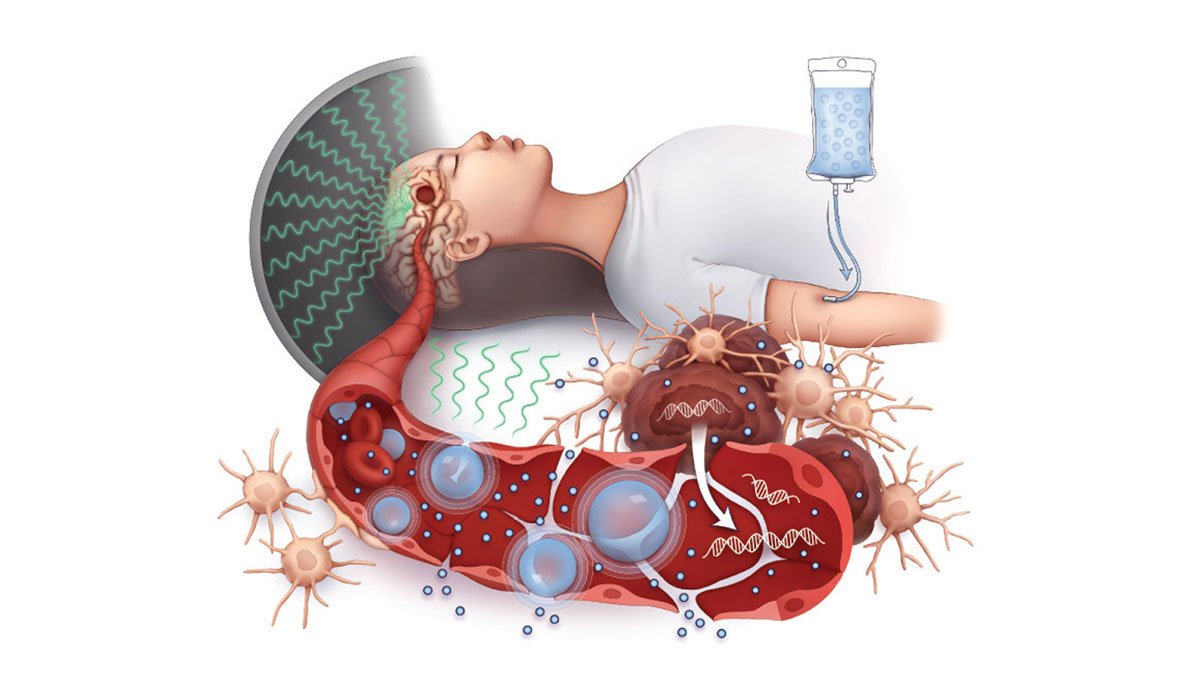
Illustration showing the use of microbubble-enhanced transcranial focused ultrasound to open the blood brain barrier and enhance drug delivery. Image from Woodworth et al., The Lancet Oncology, 2025. Distributed under a Creative Commons Attribution (CC-BY) License.
Despite standard treatment, median overall survival for glioblastoma remains less than 18 months. Three challenges drive nearly universal recurrence:
- Tumor heterogeneity
- An immunosuppressive tumor microenvironment
- Tumor cells diffusely invade nearby functioning brain tissue
These infiltrating cells mean surgery can never be curative. And the blood brain barrier severely limits the effect of systemic therapies.
For years, researchers have studied focused ultrasound as a way to temporarily open the blood brain barrier. More recently, the approach has gained momentum as a potential drug-delivery strategy in brain cancers.
New results from an international, multisite study show that not only was this technique workable and safe, it also “profoundly improved progression-free and overall survival for one of the most malignant brain tumors that we have,” says neurosurgeon Jason Sheehan, MD, an author on the paper published in The Lancet.
A First Test of Focused Ultrasound in Newly Diagnosed Glioblastoma
This study is one of the first to evaluate adding focused ultrasound to the standard treatment protocol for newly diagnosed glioblastoma. Thus far, other smaller trials of this technique had looked at recurrent glioblastoma, brain metastases, and other scenarios.
Same Chemotherapy, Better Access
In the study, researchers made only one change to the standard of care.
The current protocol for newly diagnosed glioblastoma is:
- Maximal safe surgical resection of the tumor
- Concurrent radiation + chemotherapy with temozolomide (TMZ)
- Adjuvant chemotherapy with TMZ, given monthly for up to six cycles
Study participants underwent microbubble-enhanced focused ultrasound (MB-FUS) to temporarily open the blood brain barrier before each administration of maintenance TMZ.
The first step in MB-FUS is injecting microbubbles into the bloodstream and allowing them to circulate systemically. Researchers then focus low-intensity soundwaves to the site of the tumor, causing the microbubbles to oscillate. This causes mechanical changes that temporarily open the blood brain barrier — creating a brief window for enhanced drug delivery.
Primary Goals Met: Safe, Feasible Blood Brain Barrier Opening
A phase 1/2 trial, the study’s first objectives were to demonstrate feasibility and safety.
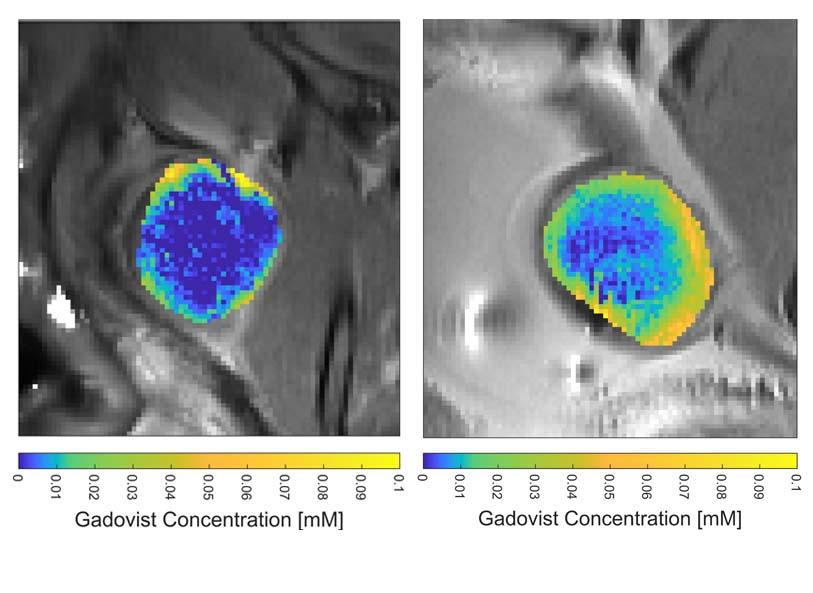
“One of the main questions was, ‘could we open the blood brain barrier?’” Sheehan says. “We did — we had evidence of that with all 34 patients. We also saw no evidence of serious harm.”
MB-FUS Significantly Extends Progression-Free & Overall Survival
Beyond meeting these goals, researchers found MB-FUS meaningfully improved survival. Median progression-free survival was 13.5 months and median overall survival was 31.3 months among participants, compared to 8.1 months and 19.3 months in the control. A total of 14, or 41%, of participants were alive at the end of the study’s 44.5 months of follow-up.
“It was a considerable extension,” Sheehan shares. “We certainly feel positively about these results.”
Opening the Door to Noninvasive Blood-Based Disease Monitoring
MB-FUS may also help address another challenge in brain tumor treatment: monitoring disease over time.
For many cancers, blood-based biomarkers help clinicians assess disease status or treatment response. PSA in prostate cancer is a familiar example. In brain cancer, the blood brain barrier limits the release of tumor-derived material into circulation.
Getting Drug In — & Biomarkers Out
But MB-FUS may help overcome that limitation. The study’s exploratory biomarker findings showed that tumor-related signals released after MB-FUS were associated with patients’ disease course.
“Not only were we able to get things into the brain that could stop or slow the malignant brain tumor, but we were able to get meaningful biomarkers out of the brain,” Sheehan explains.
These results show the potential to develop a “liquid biopsy” in which biomarkers released into the blood via MB-FUS allow for noninvasive disease monitoring.
Where Focused Ultrasound Research Goes Next
The findings add to a growing body of research exploring focused ultrasound as a treatment platform for brain tumors. At UVA Health, investigators are studying focused ultrasound in several ways.
Two studies using FUS-mediated blood brain barrier opening to enhance drug delivery in glioblastoma treatment are underway.
One combines the technique with a bispecific antibody in patients newly diagnosed with MGMT-unmethylated glioblastoma. It builds on a previous study showing the bispecific antibody induced significant antitumor-specific immune responses.
The other is testing whether MB-FUS boosts the effects of bevacizumab, the standard treatment for recurrent glioblastoma.
Additionally, another phase 1 trial is evaluating sonodynamic therapy for recurrent glioblastoma. That approach combines focused ultrasound with 5-aminolevulinic acid, or 5-ALA, to create a targeted tumor-cell-killing effect.
“The hope is that focused ultrasound can offer a precise, safe, and noninvasive way to augment other therapies,” Sheehan says.