First in the U.S. to Administer New MS Therapy: How UVA Health Advances Multiple Sclerosis Care

The ability to quickly access newly approved therapies — along with specialized diagnostic expertise — can significantly influence long-term outcomes for patients with multiple sclerosis. MS is among the most rapidly evolving fields in neurology, with new therapies reshaping the way clinicians diagnose and manage the disease. For referring physicians, selecting a center where specialists can accurately diagnose MS and offer the latest therapies is crucial.
Many patients and referring physicians in the region turn to UVA Health for this type of specialized MS care. The Division of Multiple Sclerosis and Neuroimmunology at UVA Health, led by Division Director Robert K. Shin, MD, offers a comprehensive program built around diagnostic precision, personalized care, and coordinated long-term management.
“When I began studying medicine back in the 1990s, there weren’t any treatments for MS or conditions like neuromyelitis optica spectrum disorder,” says Shin, a neurologist and neuro-ophthalmologist. “It’s been very exciting to be involved with research and clinical trials and put new treatments into practice to help our patients.”
A Therapeutic Breakthrough Delivered in Minutes, Not Hours
The latest generation of disease-modifying B-cell therapies came on the scene in 2017. That year, doctors began administering ocrelizumab via infusion for several types of MS. Ocrelizumab infusions require spending several hours at an infusion center.
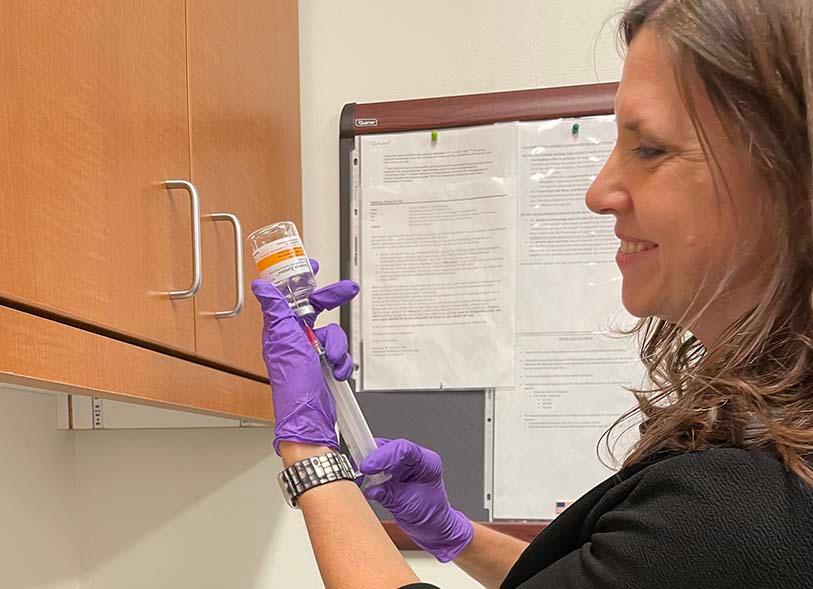
In 2025, UVA Health was the first health system in the United States to offer the newly FDA-approved Ocrevus Zunovo, a subcutaneous injectable form of ocrelizumab and hyaluronidase-ocsq.
Subcutaneous administration is a significant convenience shift for patients. Providers can administer the injectable in about 10 minutes during a routine clinic visit. Observation time is also shorter — just 15 minutes compared to an hour for the infusion.
With the injectable option, patients can visit the UVA Health clinic, receive treatment, and still have time for an MRI on the same day, if needed. That means less travel and fewer logistical challenges for patients managing a chronic neurologic disease.
Bringing the therapy into clinical practice required extensive coordination behind the scenes. Angela Holian, PharmD, a pharmacist embedded in the MS clinic, worked closely with the team to educate staff, build new workflows, manage prior authorization and benefits investigation, establish safety monitoring protocols, coordinate scheduling, and provide patient counseling. This integrated approach allowed UVA Health to move quickly from FDA approval to patient care while maintaining safety standards.
A Thorough Evaluation From a Team of Specialists
Improved access to therapy is only one aspect of UVA Health’s approach. The MS program uses a multidisciplinary clinic model to address the broad spectrum of neurologic and systemic challenges associated with MS.
“Effective care requires a lot of expertise and familiarity with the different treatment options,” Shin says. “Here at UVA Health, we have multiple providers who focus specifically on neuroimmunologic conditions and how to treat them. A new patient can expect to meet with a team that may include a neurologist, neuro-ophthalmologist, physiatrist, and rehabilitation specialist.”
Seeking the Most Effective Disease-Modifying Treatment for Each Patient
New patients typically undergo advanced MRI imaging, nerve function tests, and laboratory testing. This depth of evaluation enhances the likelihood that a patient is placed on an optimal disease-modifying therapy from the outset, reducing the potential for early neurological damage that can accrue with undertreated active disease.
Holian, who is part of the UVA Specialty Pharmacy team, emphasizes that therapy selection requires careful alignment of clinical and practical factors. “Selecting a disease-modifying therapy is about more than disease activity alone,” she says. “We look closely at patient goals, lifestyle factors, and safety considerations to help guide therapy decisions that are sustainable long term.”
Coordinated Specialty Care for Complex MS Needs
MS affects more than neurologic pathways; it impacts vision, gait, mood, cognition, and quality of life. Clinic providers offer referrals to other specialists at UVA Health, including physical and occupational therapists, urologists, and behavioral health specialists.
The program also provides access to clinical trials and emerging therapies, offering patients options that may not be available in all practice settings. These therapies can be valuable for patients who do not respond to standard treatments.
When to Refer
UVA Health’s MS team partners closely with community neurologists and primary care physicians. Referrals to the program are particularly valuable when:
- Diagnostic uncertainty exists, or imaging is atypical
- Ongoing disease activity suggests that standard therapy is insufficient
- The patient may benefit from a newly approved therapy
- Complex symptom management requires multidisciplinary expertise
“Early and accurate intervention changes the trajectory of MS,” Shin says. “If there’s any doubt about diagnosis or therapeutic strategy, we’re ready to help.”
Get the Healthy Practice Newsletter
Research-driven insights and specialty guidance for clinicians — delivered straight to your inbox.