Accelerating Breakthroughs for Alzheimer’s & Other Neurodegenerative Diseases
At UVA Health, researchers are working to shorten the distance between major scientific discoveries and the patients waiting for better treatments.
The Paul and Diane Manning Institute of Biotechnology helps make that possible. By bringing scientists, clinicians, entrepreneurs, industry partners, and advanced manufacturing capabilities together, the institute is designed to accelerate the path from laboratory discovery to clinical trials and patient care.
In this video, neuroscience and biotechnology leaders discuss how that model could shape the future of care for Alzheimer’s disease, Parkinson’s disease, epilepsy, memory loss, neuroinflammation, and other devastating neurologic conditions.
From Neuroscience Discovery to Clinical Impact
Researchers share how discoveries across neurodegenerative disease, epilepsy, memory loss, neuroinflammation, and neuronal repair could move from the lab toward patients through the Manning Institute.
John Lukens, PhD:
The Manning Institute is going to provide an opportunity to quickly accelerate discoveries in the treatments for patients to couple discovery with the infrastructure to actually move this forward in-house is going to be a game changer and it's going to be one of the only academic centers that can do this in the world.
Xuemei Huang, MD, PhD:
Alzheimer's disease is actually robbing your memory. So can you imagine you don't remember your name, your children's name, what you did yesterday?
John Lukens, PhD:
One of the major breakthroughs that we've made in the lab is defining a drainage pathway that we thought didn't exist. And this is very accessible because it's on the outside of the brain and there's real hope in targeting it to provide a treatment for these diseases.
Jaideep Kapur, PhD:
Our focus has been on understanding the role of seizures and epilepsy in Alzheimer's disease. These patients decline much faster, die two years earlier, and their brain changes suggest far more advanced disease.
Jianjie Ma, PhD:
Our lab discovered a gene called MG53 that can fix injury to the neuron and, same time, reduce inflammation.
Lori McMahon, PhD:
My lab has been very interested in the anxiety and the psychiatric changes in patients that happen before memory loss.
Xuemei Huang, MD, PhD:
So, for example, Parkinson's disease. We already have some patients live to 97, almost 100 years old, still looking well.
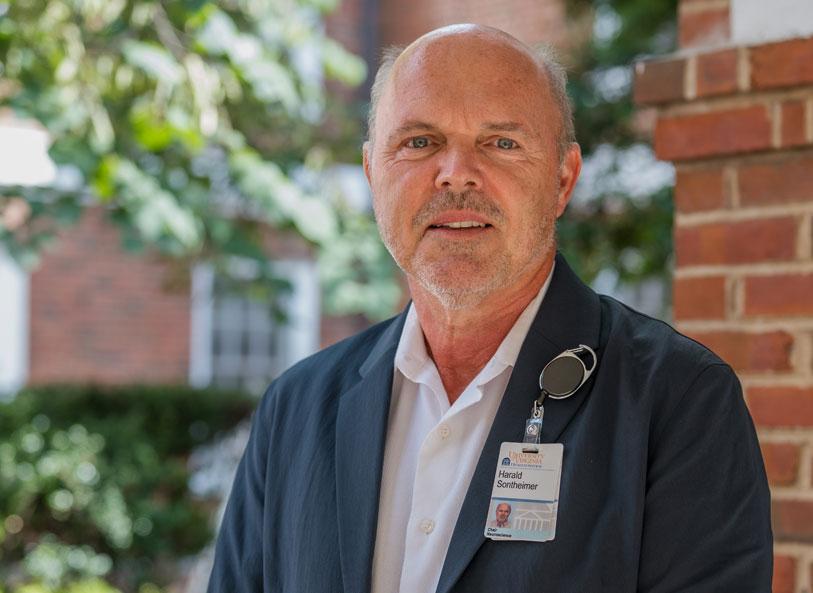
Harald Sontheimer, PhD:
We have found the cause for a very specific memory loss associated with Alzheimer's disease, social recognition memory. That is me recognizing my grandmother, my parents, my kids.
If we can just add 10 years of healthy living to a person's life, they will not experience Alzheimer's disease.
Xuemei Huang, MD, PhD:
Can we make the disease irrelevant with the family, live well with the disease? So that's achievable in the foreseeable future.
Lori McMahon, PhD:
The collaborative spirit, the can-do attitude, and the sense of urgency is going to propel us in the next five, 10 years to be the place that everyone is watching.
John Lukens, PhD:
That collective desire to finally have treatments that provide a cure for these things is really what drives me.
Xuemei Huang, MD, PhD:
Manning Institute will bring them together really under one roof, really bridge the connection between them.
Jaideep Kapur, PhD:
Manning Institute will help us bring together people all the way from drug discovery, discovering novel ways of treating Alzheimer's disease, taking it all the way through to patients.
Jianjie Ma, PhD:
We would like to be able to bring the bench innovation to clinical application. That's our goal.
Lori McMahon, PhD:
The diseases that we're going to tackle are diseases that need solutions, and the energy of the environment here and the culture and the top talent is here. So it's up to us.
John Lukens, PhD:
And I think it's going to be so motivating to be able to take what we discover and quickly accelerate it into actual treatments. And that's going to change the way that academic science is done across the world.
For neurologists, neurosurgeons, and physician-scientists, the Manning Institute represents more than a research facility. It's part of a broader effort to build the infrastructure needed to translate promising discoveries into therapies faster.
The institute will support work across cell, gene, and immunotherapies, with advanced manufacturing capabilities that allow researchers to produce therapies at clinical-trial scale — a critical step toward FDA approval that few academic institutions can achieve.
Together, their work reflects a shared goal: moving breakthrough science closer to real treatments for patients living with complex neurologic disease.
A Faster Path to New Therapies
Learn how the Manning Institute brings researchers, clinicians, industry partners, and clinical-trial-scale manufacturing together to accelerate breakthrough science.