Get to Know: Department of Urology Chair Kirsten Greene, MD, MAS, FACS
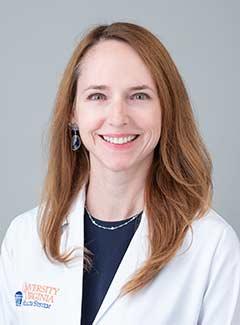
At a Glance
Title: Chair, UVA Department of Urology
Residencies: Surgery and Urology, University of California, San Francisco
Medical Degree: Johns Hopkins School of Medicine
Kirsten Greene, MD, MAS, FACS, was appointed the chair of the UVA Department of Urology in October 2019. A graduate of the University of Virginia, she returns to UVA after 20 years on the West Coast. There, Greene helped develop the robotic partial nephrectomy program and build the robotic cystectomy and robotic nephroureterectomy programs at University of California, San Francisco. In addition, she was associate chair for education, residency program director, vice chair and chief of the urology service at the San Francisco Veterans Affairs Medical Center (SFVAMC). One of the highest-volume robotic surgeons at both UCSF and SFVAMC, Greene will be working to grow the robotic prostate surgery program at UVA, among other endeavors.
You received your undergraduate degree
from UVA. Why did you decide to return to the University at this point in your
career?
I always had the
best memories of Charlottesville and UVA. Being an undergraduate here gave me
insight into what a really special place this is. There have been many changes
since I left, but the school just as beautiful as ever. There is a strong
feeling of tradition and appreciation for what UVA stands for, what we’re all about:
academics, athletics and community. And Charlottesville itself has turned into
a really cool little city — the restaurants and music scene, the vineyards. Coming
back as an adult, I have a completely new appreciation for Charlottesville;
it’s a great place to live.
In terms of my career, I was ready for a leadership opportunity. I was ready for that next step. I had already been vice chair of a division and residency director, so I was ready to take on a bigger leadership role. UVA was right for many reasons. I obviously had a familiarity and fondness for the school having been an undergrad here. When you graduate from UVA, you appreciate that it’s a special place. It’s somewhere you want to come back to. That was the foundation of it all. But it was also the faculty here. The people within the Department of Urology are smart, kind, hard-working, innovative people. Every person is someone I would want to work with. They are outstanding people who are leaders in the field, excellent clinicians and fantastic educators. So this group of people was a huge draw for me. I knew it was a once-in-a-lifetime opportunity to join this department.
I also felt like
there was an opportunity for me to grow the department. I knew I was starting
off with something excellent, but I think it can grow in a lot of different
ways.
What are your goals for the department?
It’s already a great
department. It’s historic in the field of urology, known for cutting-edge
innovation and forward thinkers. It was the first center in the U.S. to get a lithotripter,
a device to break up kidney stones with sound waves. We take it for granted now
because it’s been around forever, but it was one of the first robotic surgical
systems in the country and it was used by urologists. So UVA is a place with a
history of innovation and I want to build on that. I think we can develop the
prostate cancer program, focusing on innovation to provide the best possible
care for patients.
That's the bottom
line. I want this to be the very best place for patients to come for their care.
The best place for physicians, nurses and students to come to work and train.
And I want to continue pursuing innovative research in all areas of urology, so
patients know they have other options.
What do you feel is one of the greatest
accomplishments achieved thus far as a department?
This is the only
place in the state of Virginia to have blue light fluorescent cystoscopy, which is now recommended by guidelines. It’s
a much better way of identifying bladder cancer and we are the only place in
Virginia that has it. So we are already providing patients with the best, technologically
advanced care. I’m really proud of that; we got that when I came.
Why did you choose oncology as your
specialty?
I always wanted to
do oncology ever since I was a student in med school. I feel like you have to
find the specialty that’s most interesting to you, what you’re willing to stay
up all night to treat, what you’re willing to sacrifice for. For me, it was
always oncology. Helping cancer patients, doing surgery to remove tumors,
thinking about research to fight cancer in different ways – that’s the most
rewarding thing I’ve found for me personally. There are a lot of great areas. But
for me, the most interesting, the thing that I find is worth all the sacrifices
is treating oncology patients. It’s a privilege to help these patients.
What will be your research focus at
UVA?
UVA recently recruited a physician in nuclear medicine who does PSMA [prostate-specific membrane antigen] PET, which is what my research is focusing on as well. It’s a new way to identify metastatic prostate cancer and potentially treat the disease if combined with radiation or chemotherapy. My hope is it’s going to be a way to not only identify metastatic or recurrent prostate cancer, but to better diagnose and stage all prostate cancer. Another research interest is robotic surgery techniques — better ways to do it and better ways to teach it. The last thing I’m interested in studying further is physician burnout and resilience.
Why is physician burnout a topic that is
important to you?
When I was residency
director at UCSF, I was trying to monitor burnout among residents and intervene
early. It was interesting to examine the extent of the problem, and I found that
if you can determine what the problem is and help teach residents a way to
change or decrease the impact of that problem, then you’re helping preserve the
future of medicine in the U.S. If you get residents to figure out the problem and
how they fight it, then that’s going to trickle downstream to future physicians
in the country because we’re getting to them early as residents.
As chair of the department at UVA, now I’m responsible for everyone’s wellbeing and that’s important to me. The research that I did at UCSF actually translates very well not just to residents, but faculty. Finding out what’s most important to people and how to keep them engaged, how to create a culture of resilience that decreases burnout — this is now a huge part of my job.
Do you have any strategies you’ve found
to be effective at mitigating burnout?
It sounds obvious, but one thing we found in our research was simply making people feel heard and giving them a voice makes a difference. If you give them an opportunity to say what it is that’s causing them stress or burnout or making their work-life balance wrong, and then not just listen, but actually empower them to make a change rather than just presumptively making a change for them, that was incredibly impactful on decreasing burnout. It’s important to listen to people to make sure they know it’s a safe space to critique.
Other studies have shown
that giving people a sense of control over their environment decreases burnout.
For example, the ability to control a vacation schedule or call schedule or something
simple like that. Burnout is multifactorial. It’s not just EMR or long hours or
too many patients. It’s all of it. But if I have an overwhelming environment
and no ability to change that, that’s when it leads to burnout. If you put
someone in an overwhelming, stressful environment, but you give them the ability
to make a change, that helps empower them and decreases burnout.
How do you view your relationship with
referring providers and how do you prefer to communicate with them?
Ultimately, the
patient benefits if we work as a team and it’s more rewarding if we can connect
as colleagues and friends. Referring providers can reach me by email, text or
phone whenever they need to reach me. My goal is to make it as easy as possible
to get patients into our system. I see that as part of my role. Referring
providers shouldn’t hesitate to contact me if there’s something I can do to
help.
To schedule an in-person visit from Dr. Greene, please contact our Physician Relations team.
To refer a patient to UVA Urology, call UVA Physician Direct at 800.552.3723.
Subscribe to Healthy Practice
Get UVA Health news & information specifically for referring physicians