A Lipid-Based Approach to Stratification & Treatment Resistance in AML
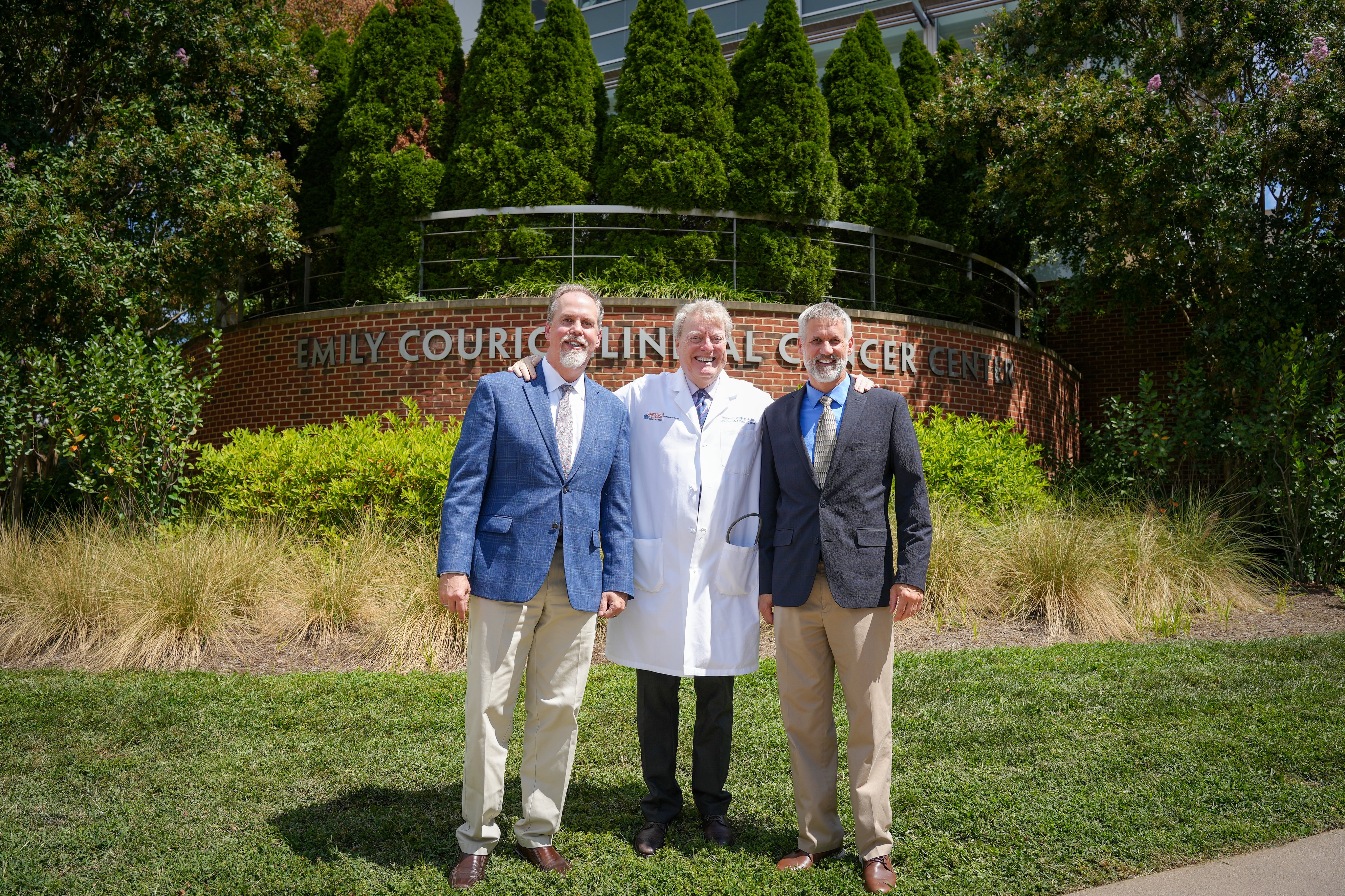
From left, Charles Chalfant, PhD; Thomas P. Loughran Jr., MD; and David Feith, PhD
Acute myeloid leukemia remains one of the most lethal hematologic malignancies despite an influx of new therapies over the past decade. While advances such as mutation-directed agents and venetoclax-based regimens have expanded treatment options since 2017, virtually all AML patients develop relapsed/refractory disease. The 5-year survival rate has changed little and remains around 30%.
Despite advances in genomic profiling, actionable mutations remain limited for AML. Consequently, a substantial proportion of patients continue to be classified as intermediate risk — forcing clinicians to make high-stakes treatment decisions while prognosis and appropriateness of aggressive therapies are unclear.
Researchers at UVA Health are advancing a complementary approach to AML biology that looks beyond genomics alone to better explain why patients respond differently to treatment. The team has launched a major, multiyear effort, Ceramide-Directed Therapeutics for Treatment of AML, building on prior studies demonstrating that sphingolipid profiles can stratify AML patients by treatment response. The program now aims to translate those findings into clinically actionable risk stratification tools and therapeutic strategies.
The work recently received a $13 million, five-year Program Project (P01) award from the National Cancer Institute, reflecting confidence in the program’s scientific foundation and translational potential.
Building the Biological & Translational Foundation
The new program builds on more than a decade of collaborative work by the research team, supported through a previous multi-project P01 award, which established both the dysregulation of sphingolipid metabolism in AML and its potential as a therapeutic target.
Through their earlier program project, the research team uncovered a consistent pattern of disrupted sphingolipid metabolism across AML — revealing that lipid signaling plays a central role in treatment response and resistance. Rather than acting as passive bystanders, sphingolipids emerged as active drivers of leukemia cell survival, influencing whether therapies triggered cell death or were ultimately evaded.
In particular, the team demonstrated that AML cells frequently alter ceramide metabolism — suppressing the accumulation of ceramides that promote cell death while converting them into alternative lipid species that support survival and proliferation. This adaptive rewiring helps explain why many AML therapies initially appear effective but fail over time as leukemia cells develop resistance.
Crucially, these metabolic patterns were not apparent through genomic or cytogenetic analysis alone. By profiling sphingolipids directly, the researchers identified biologically distinct AML subtypes associated with markedly different treatment responses — including a high-risk subgroup with a significantly increased likelihood of therapeutic failure. These findings provided a new lens for understanding disease behavior, particularly among patients whose risk status remained ambiguous under existing classification schemes.
New Stratification Tools to Illuminate the Intermediate Risk Group
In their previous work, the researchers identified two biologically distinct AML subtypes based on sphingolipid metabolism — SMhigh vs SMlow. These subtypes capture how cells in AML process ceramides and related sphingolipids — pathways closely linked to cell survival and response to therapy.
Patients classified as SMhigh exhibited metabolic patterns associated with enhanced ceramide detoxification and a markedly higher risk of treatment resistance and disease persistence. In contrast, SMlow patients showed sphingolipid profiles more consistent with effective ceramide-mediated cell death and more favorable responses to standard therapies. Importantly, this lipid-based classification stratified outcomes independent of existing genomic and cytogenetic frameworks.
Among patients traditionally categorized as intermediate risk, sphingolipid profiling provided a biologically grounded means of reallocating patients toward higher- or lower-risk categories, helping guide decisions on treatment intensity, clinical trial enrollment, and therapeutic sequencing.
Stress-Testing Sphingolipid Stratification for Clinical Utility
The current program project aims to refine, validate, and standardize this approach across larger cohorts, while also advancing methods to make sphingolipid profiling more practical for clinical use. Together, these efforts are designed to support the development of a robust, clinically actionable stratification tool to complement existing diagnostic workflows and inform treatment decisions in AML.
To ensure the approach can withstand real-world clinical application, the team is prioritizing rigorous validation across independent patient populations.
“Our new studies build on these early findings using expanded data sets from well-characterized clinical trial cohorts, along with blinded analyses designed to validate this stratification in a clinical setting,” Charles Chalfant, PhD, says.
Beyond their initial SMhigh/SMlow classification, the researchers are also exploring additional markers for stratification. “We are expanding to low abundance sphingolipids that may also stratify patients as to prognosis and pertinent treatment options, which our preliminary data support,” Thomas P. Loughran, Jr., MD, director of UVA Comprehensive Cancer Center explains.
Beyond its role in risk stratification, sphingolipid biology also offers a therapeutic vulnerability in AML. Ceramide accumulation is a key mediator of cell death for many AML therapies, yet leukemia cells frequently evade this effect by activating metabolic pathways that neutralize ceramides and convert them into lipid species that promote survival.
This adaptive rewiring allows AML cells not only to escape apoptosis but to become metabolically dependent on pro-survival sphingolipids, contributing to treatment resistance and disease persistence. By targeting ceramide detoxification pathways, the researchers aim to disrupt this survival advantage while restoring ceramide-mediated cell death.
According to the team, interfering with ceramide metabolism affects leukemia cells on multiple levels.
“Blocking ceramide detoxification pathways has a two-pronged effect — increasing ceramide levels that inhibit AML cell growth, while removing pro-survival sphingolipids that leukemia cells depend on for sustained metabolism and survival,” explains Loughran.
Enabling Ceramide-Based Therapy Through Nanotechnology
A central example of this therapeutic strategy is a C6-ceramide nanoliposome (CNL) developed through the team’s earlier program project. In preclinical AML models, CNL enabled sustained delivery of pro-death ceramide to leukemia cells, restoring apoptotic signaling and enhancing the activity of existing anti-leukemia agents. These studies supported FDA approval to initiate clinical evaluation of CNL, including an ongoing phase I trial in patients with relapsed or refractory AML.
The nanoliposomal formulation, the researchers say, was critical to making ceramide-based therapy viable in humans.
“Our C6-ceramide nanoliposome was designed to overcome the poor solubility, distribution, and short half-life that have limited ceramide delivery in patients,” David Feith, PhD, says. “We’ve also shown that delivering exogenous ceramide can boost the efficacy of existing AML therapies, particularly when used in combination.”
Integrating Ceramide Targeting With Established AML Therapies
Importantly, this strategy is designed to complement existing AML treatments. Many patients with relapsed or refractory AML develop resistance mechanisms that blunt the pro-apoptotic effects of commonly used regimens, limiting the durability of response even with newer agents.
This interaction may be particularly relevant in the context of venetoclax-based therapy, which has become a cornerstone of AML treatment.
“Many patients with relapsed or refractory AML develop survival mechanisms that subvert the pro-apoptotic effects of venetoclax, and our findings suggest these pathways can be reversed when venetoclax is combined with sphingolipid-targeting agents,” Chalfant shares.
Consistent with the program’s translational focus, ongoing and planned clinical studies are prioritizing patients with relapsed or refractory AML, where unmet need is greatest and where ceramide-targeted strategies may offer the most immediate clinical impact. Planned phase I/II studies will further evaluate CNL in combination with established and emerging AML therapies, including venetoclax-based regimens, as part of a broader effort to integrate sphingolipid-targeted approaches into the therapeutic landscape.
The Path From Discovery to Clinical Impact
For clinicians, the promise of this work lies not only in its biological insight, but in its deliberate focus on translation. The program is structured to move discoveries from patient samples to therapeutic testing and back again — with validation, standardization, and clinical feasibility built in from the outset.
As these efforts progress, sphingolipid profiling and ceramide-targeted therapies may offer new ways to refine risk assessment, guide treatment intensity, and expand options for patients with relapsed or refractory AML. In a disease where outcomes have remained stubbornly poor despite therapeutic advances, the researchers believe that addressing resistance at its metabolic roots may open a new path forward.